
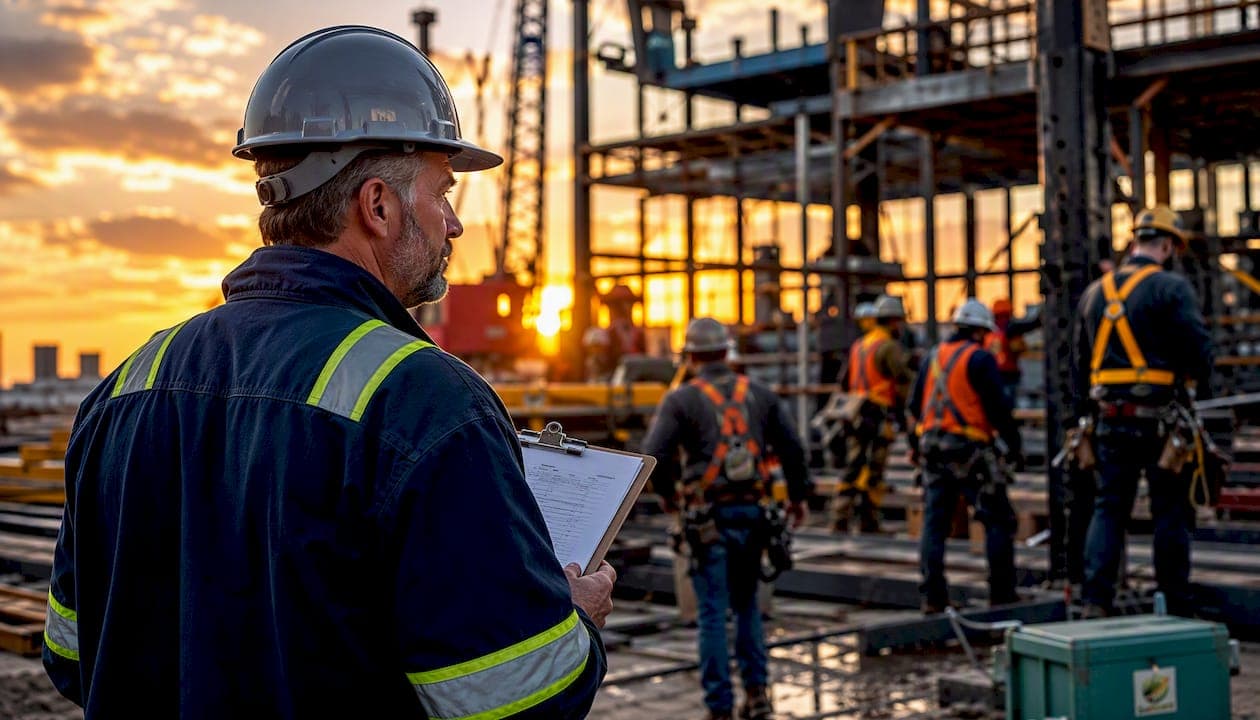
The foreman is the on-site owner of the Job Safety Plan, responsible for planning, enforcing, documenting, and responding to every safety condition that shifts during a work shift. No one else on the crew has that combination of authority and proximity to the work.
Here is what that looks like in practice, before you read any further:
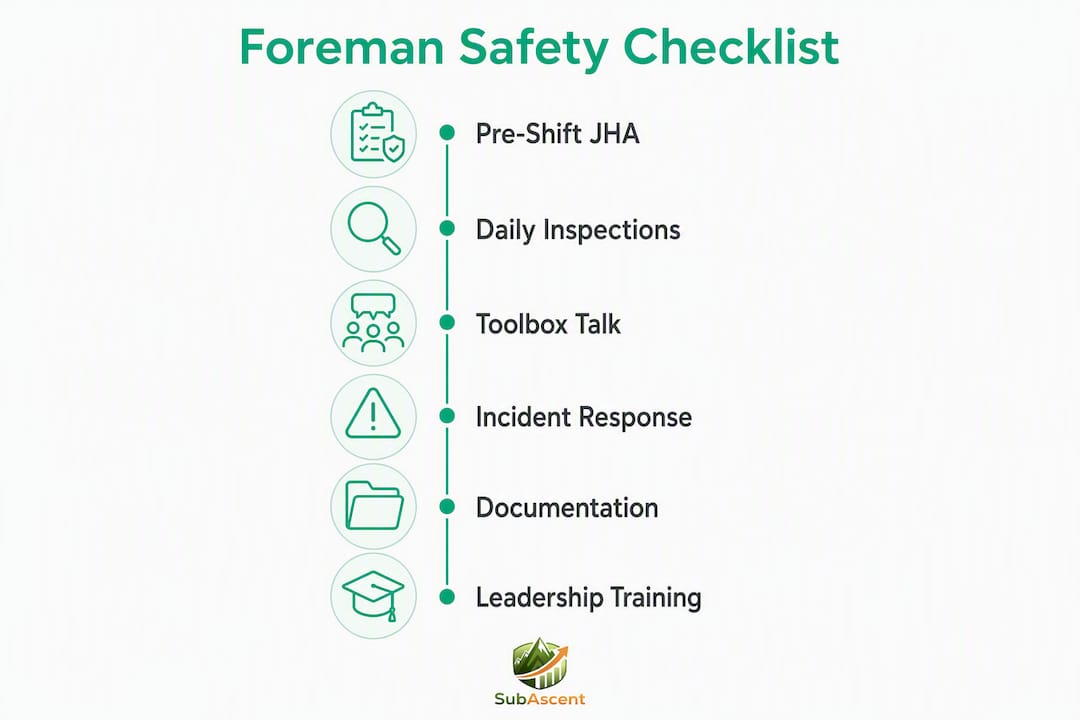
- Complete a Job Hazard Analysis (JHA) before the first worker touches the task
- Run a toolbox talk at shift start and whenever hazards change
- Enforce PPE, permits, and stop-work authority without exception
- Document inspections, sign-ins, and incidents the same day they happen
- Feed near-miss findings back into the JHA before the next shift
Safety is not a separate chore from production planning. Foremen who treat it that way see more downtime, more rework, and more OSHA exposure. The ones who build it into the daily task sequence keep crews moving and keep the job profitable.
Pro Tip: Print the five items above and tape them inside your site binder. If you can check all five by 8 AM, your shift is set up right.
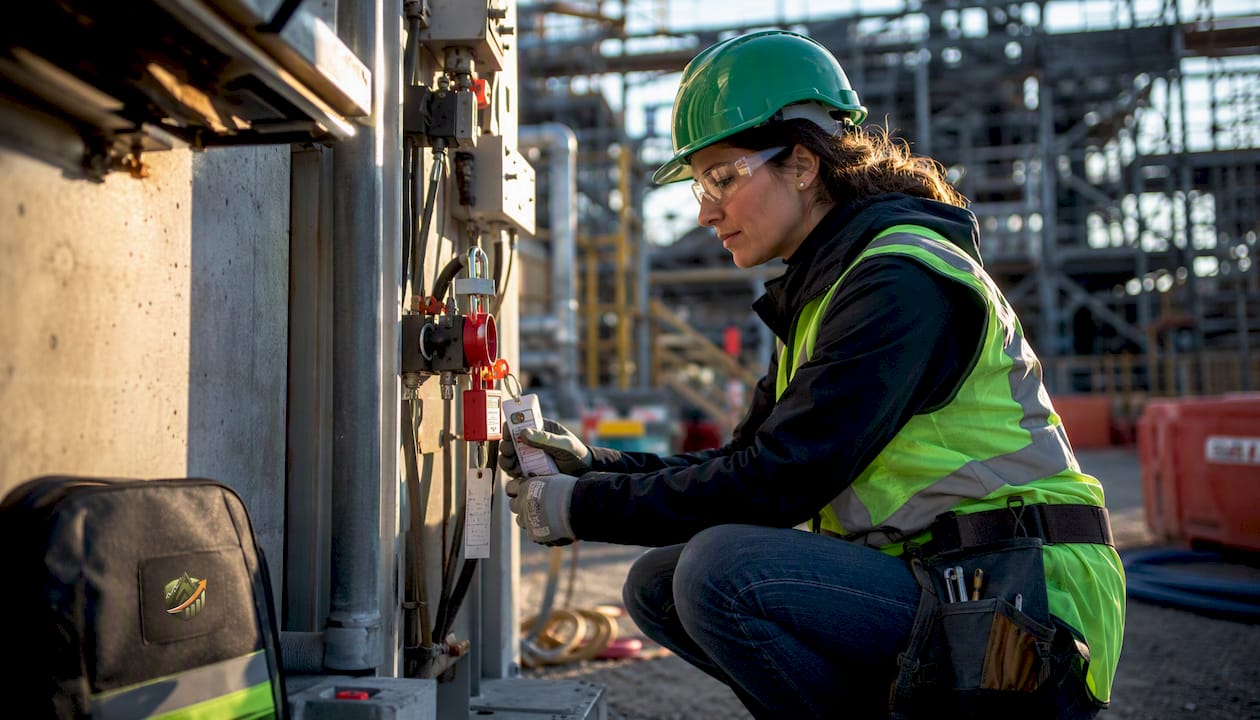
Table of Contents
- What the foreman actually owns in a job safety plan
- How to run a JHA before the task starts
- Daily inspections and toolbox talks that actually change behavior
- Incident and near-miss response: what the foreman must do first
- Documentation and OSHA recordkeeping the foreman must support
- Building foreman competence in safety leadership
- How to put the foreman's duties inside the written job safety plan
- Practical checklists and template fields you can use today
- Key Takeaways
- The part most safety programs get wrong
- Subascent helps foremen capture safety records faster
- Useful sources
What the foreman actually owns in a job safety plan
The foreman is the primary implementer of the safety program on any specialty trade job. That is not a title. It is a daily list of decisions that either protect workers or expose them.
Core responsibilities every foreman must own:
- PPE enforcement. Verify that every crew member has and wears the correct PPE before work starts. No exceptions for veterans, no exceptions for short tasks.
- Permits and work authorization. Confirm that hot-work permits, confined-space entry permits, and excavation authorizations are in hand before the crew moves.
- Stop-work authority. Any foreman on any US specialty trade job has the right and the obligation to stop work when an uncontrolled hazard appears. Use it.
- Job briefings and pre-task plans. Walk the crew through the task, the hazards, and the controls before the first tool comes out.
- Equipment checks. Inspect ladders, lifts, power tools, and rigging at the start of the shift. Tag out anything that fails.
- Supervision and coaching. Stay visible. Correct unsafe acts immediately and explain why, not just what.
- Coordination with other trades. When two trades are working in the same zone, the foremen must agree on sequencing and shared hazard controls before either crew starts.
- Emergency response. Know the site emergency plan, the muster point, and who calls 911. Brief the crew on day one.
Trade-specific focus areas matter here. An electrical foreman's sharpest daily concern is lockout/tagout (LOTO) verification before any energized-circuit work. A masonry foreman checks scaffold ties, guardrails, and fall-protection anchors every morning. An HVAC foreman running confined-space or rooftop work verifies ventilation, atmospheric testing, and rescue equipment before entry. The hazard profile changes by trade; the accountability structure does not.
Real compliance looks like a foreman who corrects a worker putting on a hard hat wrong, signs the JHA before the crew signs it, and stops a task when the site conditions change. Check-the-box compliance looks like a foreman who hands out a pre-printed form, collects signatures, and files it without reading it. Inspectors and incident investigators can tell the difference in about five minutes.
How to run a JHA before the task starts
The JHA is the foreman's primary planning tool. Run it before the first worker starts the task, not after the crew has already set up.
The practical sequence is straightforward. Break the task into its discrete steps, no more than ten for most trade tasks. For each step, identify what could go wrong: struck-by, fall, electrical contact, caught-in, chemical exposure. Then select a control for each hazard, working down the hierarchy: eliminate the hazard first, substitute if you can't eliminate, engineer a barrier, add an administrative control, and use PPE last. Assign who is responsible for each control and confirm the competent person is on site before work begins.
When to re-run or update the JHA:
- New equipment or tools are brought onto the task
- Site conditions change (weather, adjacent work, new overhead lines)
- A crew member is replaced, especially with someone less experienced
- A near-miss or incident occurs
- The schedule shifts and the task sequence changes
- Any scope change that alters the steps or the hazards
Sample JHA template fields (copy these into your own form or mobile app):
| Field | What to capture |
|---|---|
| Task name | Specific activity, not just "electrical work" |
| Job steps | Numbered sequence of discrete actions |
| Hazards per step | One hazard per row; be specific |
| Controls selected | Hierarchy of controls applied |
| PPE required | By task step, not generic |
| Competent person | Named individual, not a role |
| Crew sign-offs | Printed name, signature, date |
| Foreman sign-off | Signature and time |
| Review trigger | Condition that would require a re-run |
Pro Tip: Keep the JHA to one page. A two-page JHA that gets read beats a five-page one that gets filed.
Daily inspections and toolbox talks that actually change behavior
Inspections and toolbox talks are the primary enforcement and training tools a foreman uses every shift. Foremen should document and use these as repeatable field practices, not one-time orientation events.
Frequency and cadence:
- Daily walkthrough at shift start, before work begins. Check housekeeping, PPE availability, equipment condition, permit status, and fall-protection anchors. Takes five minutes if you know what you're looking for.
- Toolbox talk at shift start, every day. Three to five minutes, one topic, crew input required.
- Mid-shift check when conditions change: weather rolls in, adjacent trade starts overhead work, a delivery blocks an egress path.
- Weekly deeper inspection covering the full site: fire extinguisher locations, first-aid kit stock, emergency signage, and any equipment that has been on site long enough to develop wear issues.
Daily inspection checklist fields:
- Housekeeping: walkways clear, materials stacked, debris removed
- PPE: hard hats, safety glasses, gloves, high-vis, fall protection in place
- Equipment: ladders tagged and in good condition, power tools guarded, lifts inspected
- Permit verification: hot work, confined space, excavation permits current
- Fall-protection anchors: tied off, rated, inspected
- Hazard communication: SDS sheets accessible, chemical containers labeled
- Emergency: exit paths clear, first-aid kit stocked, emergency numbers posted
Toolbox talk structure (3–5 minutes):
A good toolbox talk has five parts. State the topic in one sentence. Describe the specific risk on this job, not a generic industry stat. Explain the control the crew will use today. Ask one question and let two or three crew members answer. Close with the sign-in sheet. That is it. A foreman who reads from a laminated card every morning will lose the crew by Wednesday. Vary the delivery: use a photo from yesterday's inspection, reference a near-miss from another job, ask a newer worker to explain the control back to the group.
Photo documentation: Photograph every hazard you find and every corrective action you take. Use your phone's native camera so the timestamp and GPS metadata are embedded automatically. A photo of a guardrail before and after you tighten it takes ten seconds and eliminates an argument later. During an incident review, timestamped photos cut investigation time significantly and support accurate root-cause findings.
Incident and near-miss response: what the foreman must do first
The single most urgent action after any incident is to secure the scene and render aid. Everything else follows from that.
Immediate sequence:
- Stop work in the affected area.
- Render first aid or call EMS if the injury requires it.
- Preserve the scene: do not move equipment or materials until the investigation is complete, unless doing so is necessary to prevent further injury.
- Notify your superintendent or safety manager immediately, by phone if needed.
- Document the scene with photos before anything is disturbed.
For a near-miss, the sequence is the same except EMS is typically not involved. Near-misses get the same investigation priority as recordable incidents because they share the same root causes.
Basic field investigation: Walk the sequence of events backward from the moment of injury or near-miss. What was the last safe condition? What changed? Check the equipment involved for defects or improper setup. Talk to witnesses separately and record their accounts in writing. Look for human factors: fatigue, time pressure, unfamiliar task, inadequate briefing.
Documentation timelines: Foremen are responsible for promptly reporting and investigating injuries and near-misses and sharing root-cause findings with management. A near-miss report should reach your safety manager the same day. A recordable incident triggers OSHA reporting requirements that the employer must meet, and the foreman's accurate field documentation is what makes that possible.
Feeding findings back into the JHA: Every investigation should produce at least one corrective action. If the root cause was a missing control, add it to the JHA before the task restarts. If it was a training gap, document it and schedule the training. The JHA is a living document, not a one-time form.
Pro Tip: Keep a pocket notebook on site. Write the time, location, and a two-sentence description of any near-miss within five minutes of it happening. Memory degrades fast under stress, and that note becomes the foundation of your investigation.
Documentation and OSHA recordkeeping the foreman must support
The foreman is the primary source of timely, accurate field records. That paper trail, or mobile trail, is how compliance gets proven when OSHA shows up or a dispute goes to litigation.
Documents the foreman owns or contributes to:
- Daily inspection logs (signed, dated, specific)
- JHAs (completed before task start, updated when conditions change)
- Toolbox talk sign-in sheets (topic, date, crew signatures)
- Incident and near-miss reports (narrative, photos, witness statements)
- Equipment inspection tags and logs
- Training records for crew members under the foreman's supervision
- Permit records (copies of issued permits with foreman acknowledgment)
Retention: Most OSHA records must be retained for a minimum of five years. OSHA 300 logs, 300A summaries, and 301 incident reports follow that standard. Check with your safety manager for company-specific retention policies, since many specialty trade subs retain records longer for insurance and litigation purposes.
OSHA basics the foreman must support: Under OSHA's Recommended Practices for Safety and Health Programs, workers and their representatives are involved in identifying and reporting hazards and investigating incidents. The foreman is the field link in that chain. Specifically: severe injuries (hospitalization, amputation, loss of an eye) require employer reporting to OSHA within 24 hours; a fatality requires reporting within 8 hours. The foreman does not make that call directly, but the foreman's accurate, immediate documentation is what the employer uses to meet those deadlines.
Practical record-keeping tips:
- Use timestamped photos as the primary evidence layer; add a short written narrative the same day
- Get crew signatures on JHAs and toolbox talk sheets before work starts, not at the end of the shift
- Write narratives in plain language: what happened, when, where, who was involved, what was done
- Store digital records in a shared folder or field reporting app that your superintendent and safety manager can access without asking you for a copy
Good documentation also has a direct business impact. Foremen who understand the economic cost of accidents make better decisions about when to slow down and when to call for help. An incident that sidelines one worker for two weeks costs far more than the time spent on a thorough JHA.
Building foreman competence in safety leadership
Training foremen in management and leadership, not just technical tasks, converts them from rule-enforcers into genuine extensions of the company's safety strategy. That distinction matters for retention, productivity, and incident rates.
Core competency checklist for foremen:
- JHA facilitation: can lead a crew through a pre-task analysis without reading from a script
- Toolbox talk delivery: can run a five-minute talk that generates crew participation
- Incident investigation basics: can identify root causes beyond "worker error"
- Permit and LOTO knowledge: understands the permit system for the trades they supervise
- Conflict management: can address a non-compliant worker without escalating unnecessarily
- Hazard recognition: can identify struck-by, fall, electrical, and caught-in hazards on sight
Training sequence for new vs. experienced foremen:
A new foreman needs the fundamentals first: OSHA 30-Hour Construction, a hands-on JHA workshop, and a supervised toolbox talk before running one solo. An experienced foreman who has never had formal leadership training benefits more from a short supervisory skills course and a coaching relationship with a senior safety manager than from repeating OSHA basics they already know.

Effective foremen lead by example: walking the talk, enforcing rules consistently, and mentoring inexperienced workers. Crews watch foremen for cues about what the company actually prioritizes. A foreman who skips his own hard hat while checking the crew's sends a message no toolbox talk can undo.
For subcontractor owners thinking about smart leadership hiring, the foreman's safety competence should be part of the hiring criteria, not an afterthought addressed during onboarding.
Pro Tip: Pair a new foreman with your most safety-consistent veteran for the first 30 days. Formal training gives them the vocabulary; watching someone do it right gives them the habit.
How to put the foreman's duties inside the written job safety plan
The most common failure in construction safety management is a Job Safety Plan that lives in the office while the work happens in the field. Most safety plans fail because they stay in the office; foremen must translate policies into small, field-executable actions or the plan gets ignored.
The fix is a responsibility matrix inside the written Job Safety Plan that ties every safety duty to a role, a frequency, and a required record.
Sample responsibility matrix:
| Role | Duty | Frequency | Required record | Backup |
|---|---|---|---|---|
| Foreman | Complete JHA | Before each new task | Signed JHA form | Superintendent |
| Foreman | Run toolbox talk | Daily (shift start) | Sign-in sheet | Lead worker |
| Foreman | Daily site inspection | Each shift | Inspection log | Superintendent |
| Foreman | Incident/near-miss report | Same day as event | Incident report form | Safety manager |
| Superintendent | Review JHAs and inspection logs | Weekly | Reviewed and initialed logs | Project manager |
| Safety manager | Audit compliance | Monthly | Audit report | Owner |
Review cadence: Daily reviews happen at the field level, the foreman signing off on inspections and JHAs. Weekly, the superintendent reviews those records and flags gaps. Monthly, the safety manager audits the full set and updates the Job Safety Plan if scope, crew, or site conditions have changed. Any incident or near-miss triggers an immediate unscheduled review.
Making it enforceable: Include the matrix in foreman onboarding. Tie it to performance reviews. Audit it quarterly. A matrix that exists only in the written plan but never gets referenced during a foreman's first week on the job is decoration.
Practical checklists and template fields you can use today
Practical jobsite toolkits are most effective when kept short enough for daily use. These fields are designed to be copied into your own form, mobile app, or site binder.
Daily safety report fields:
- Date and shift start time
- Crew names present
- Tasks performed (reference JHA number)
- Critical hazards identified
- Controls confirmed in place
- PPE compliance: yes / no / corrective action taken
- Equipment inspections completed: yes / no / items tagged out
- Permits verified: yes / no / permit numbers
- Photos attached: yes / no / count
- Near-misses or incidents: description or "none"
- Corrective actions taken or pending
- Foreman signature and time
JHA fields that must appear on every pre-task plan:
- Task name and location
- Numbered job steps
- Hazard identified per step
- Control selected (hierarchy of controls)
- PPE required per step
- Competent person named
- Crew signatures (printed name + signature + date)
- Foreman signature and time
- Review trigger noted (what condition would require a re-run)
Using these in the field: Store the daily report and JHA template in the same folder, physical or digital. The foreman signs both before work starts. Photos attach to the daily report. At shift end, the completed report goes to the superintendent, either as a paper copy or a shared digital file. Standardize the template across your trades, then add trade-specific rows where needed: an electrical foreman adds a LOTO verification row; a roofing foreman adds a fall-protection anchor inspection row.
For foremen managing crew hours alongside safety documentation, a single mobile daily report that captures both saves significant time and reduces the chance that safety entries get skipped when the shift runs long.
Key Takeaways
The foreman's role in a job safety plan is not administrative support. It is the primary mechanism by which a written safety plan becomes real, field-level protection for every worker on the crew.
| Point | Details |
|---|---|
| JHA before every task | Complete and sign a JHA before the first worker starts; update it whenever conditions, crew, or equipment change. |
| Daily documentation | Sign inspection logs, toolbox talk sheets, and incident reports the same day, every day, with timestamped photos. |
| Responsibility matrix | Embed the foreman's duties in the written Job Safety Plan with a role, frequency, required record, and backup for each task. |
| Leadership over paperwork | Foremen who lead by example and coach non-compliance drive better crew behavior than those who rely on forms alone. |
| Subascent for field reporting | Subascent's CrewTrack mobile app helps foremen capture JHAs, photos, and crew sign-offs in one place, feeding daily reports directly to the superintendent. |
The part most safety programs get wrong
Most safety programs are written by people who are not on the tools. That is not a criticism; it is just a structural reality. The safety manager writes the plan, the owner signs it, and then it lands on the foreman's desk with the implicit expectation that it will somehow translate into what happens at 7 AM on a wet Tuesday in November.
What actually works is building the foreman into the plan design, not just the plan execution. When a foreman helps write the JHA template for their trade, they understand why each field exists. When they help set the inspection cadence, they own it. The difference between a foreman who enforces safety and one who performs safety compliance is almost always whether they had any say in how the system was built.
The other thing most programs underestimate is the cost of inconsistency. A foreman who enforces PPE on Monday and lets it slide on Friday because the job is running behind teaches the crew exactly one thing: the rules are negotiable when the schedule is tight. That lesson is harder to undo than any incident investigation.
The foreman's job is to make the right behavior the easy behavior. Short JHAs that fit on one page. Toolbox talks that take four minutes and feel relevant. Inspection checklists that cover the actual hazards on this job, not a generic list from a template written for a different trade. When the tools fit the work, foremen use them. When they don't, the tools get filed and the work gets done without them.
Subascent helps foremen capture safety records faster
Foremen on specialty trade jobs, electrical, HVAC, masonry, roofing, fire protection, and others, spend real time every shift on JHAs, inspection logs, toolbox talk sign-ins, and daily reports. When those records live on paper or in disconnected spreadsheets, they get lost, arrive late, and create gaps that show up at the worst possible moment.

Subascent's CrewTrack mobile app gives foremen pre-built fields for JHAs, photo attachments with automatic timestamps, crew sign-offs, and daily report generation that goes straight to the superintendent without a phone call. Records stay organized, accessible, and export-ready for OSHA reviews or GC audits. Subcontractor owners get visibility into what is happening on every job without chasing their foremen for paperwork.
If your crew is still running safety documentation on paper or generic forms, start a free trial at Subascent and see how much time the right field reporting tool saves on day one.
Useful sources
These are the primary references used throughout this article. Each is worth bookmarking for your own Job Safety Plan development and compliance checks.
- OSHA Job Hazard Analysis (Publication 3071) — The standard federal reference for JHA methodology. Use this to validate your JHA template fields and the hierarchy of controls your foremen apply.
- IECNE Toolbox Talks: Job Site Foreman Safety Responsibilities — A concise, field-ready breakdown of foreman incident reporting duties and documentation requirements. Good model for toolbox talk structure.
- Tulsa JATC Foreman Safety Module — Covers job briefings, pre-task planning, and the integration of safety into daily production planning. Practical and trade-focused.
- IRMI: The Injury-Free Construction Site and the Foreman — Expert commentary on why foremen are an underutilized safety resource and how to develop their leadership capacity.
- NCCER: The Essential Role of a Construction Foreman in Project Success — Industry perspective on foreman competencies, including safety leadership and field toolkit design.
- Ameren General Foreman Supervisors Toolkit — Practical supervisory guidance covering job briefings, leading by example, and mentoring crew members on safety behaviors.