

Subcontractor prequalification submission is the process of compiling and presenting your company's verified credentials, financials, insurance, and safety records to qualify for bidding on construction projects. General contractors use these submissions to filter out high-risk firms before awarding contracts. For electrical, plumbing, HVAC, masonry, roofing, and other specialty trade subs, a weak or incomplete submission means getting cut from the bid list before you ever price a job. This guide covers exactly what documents you need, how to organize them, and how to move through the review process without losing time or opportunities.
What documents does a prequalification submission require?
The contractor prequal checklist covers more ground than most trade subs expect the first time they go through it. General contractors want proof that you can do the work, pay your people, carry the right insurance, and finish without creating liability for them. Every document in your packet serves one of those four purposes.
The core documents every submission needs:
- W-9 and business license. Confirms your legal entity, tax ID, and right to operate in the project's jurisdiction.
- Insurance certificates. Standard GL requirements are $1M per occurrence and $2M aggregate. You also need statutory workers' compensation limits and $1M combined single limit for commercial auto. Have your broker issue certificates naming the GC as additional insured before you submit.
- Bonding capacity letter. Your surety agent issues this. It states your single and aggregate bond limits. GCs use it to confirm you can handle the contract size. If you need to strengthen this number, improving bonding capacity starts with your financial statements.
- Financial statements. CPA-prepared statements for the last two to three years are the standard. Bank reference letters and credit references support them. GCs are checking for positive working capital and no pattern of liens or judgments.
- OSHA 300 logs and EMR letter. Your Experience Modification Rate tells the GC how your safety record compares to the industry average. An EMR above 1.0 raises flags. An EMR below 1.0 is a competitive advantage.
- Safety manual. A current, signed safety program shows you have written procedures, not just good intentions.
- Trade licenses and certifications. Electrical contractors need state licensing. Fire protection subs need NICET certifications. Glazing and low-voltage trades have their own requirements. Include every license relevant to the project scope.
- Project references. Match references to similar scope, complexity, and dollar value. A roofing sub bidding a $2M commercial project should list commercial roofing references, not residential reroof jobs. Verify that every contact listed is still reachable.
| Document | Purpose | Typical verification method |
|---|---|---|
| Certificate of insurance | Confirms coverage limits and additional insured status | Direct confirmation with broker |
| EMR letter from carrier | Measures safety performance vs. industry average | Insurance carrier letter |
| CPA financial statements | Demonstrates financial stability and cash flow | Reviewed or compiled statements |
| Bonding capacity letter | Confirms ability to bond the contract | Surety agent letter |
| OSHA 300 logs | Documents recordable incidents over prior years | Signed copies submitted directly |
| Trade licenses | Confirms legal authority to perform the work | State licensing board verification |
| Project references | Demonstrates relevant experience | GC contacts listed contacts directly |
How to prepare and organize your prequalification packet
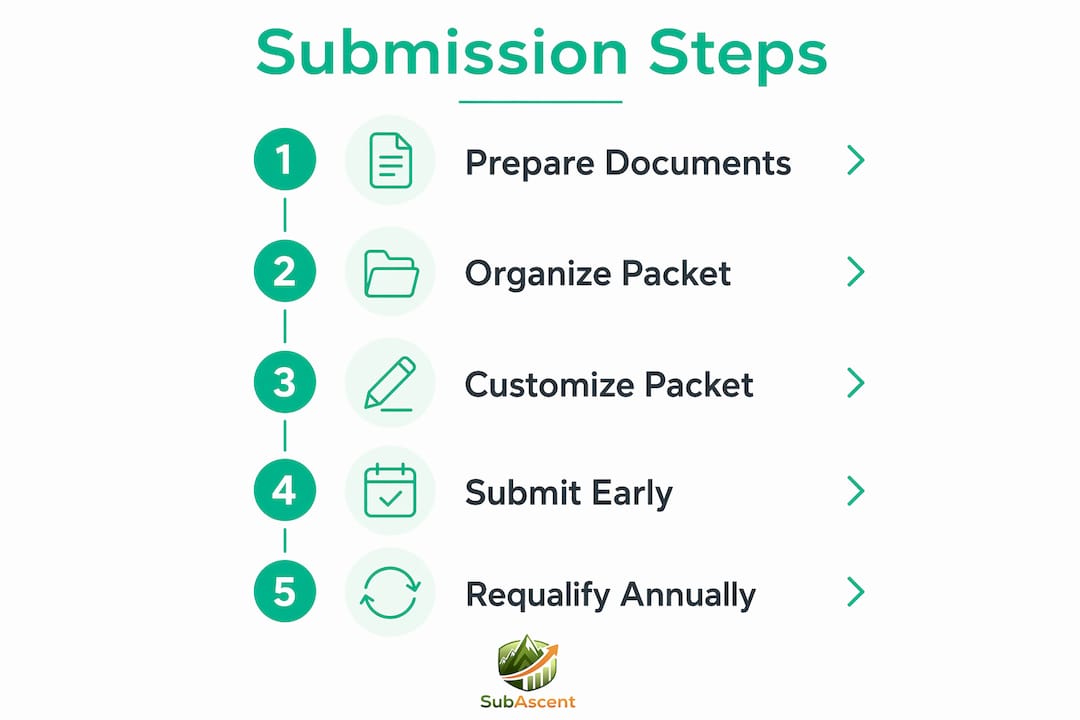
The single best thing you can do for your prequalification process is build a master folder and keep it current. Maintaining a live prequalification folder updated quarterly cuts your submission turnaround from days to hours. That matters when a GC sends a request with a 48-hour deadline.

Your master folder should contain every document listed above, organized so anyone in your office can pull it together without hunting through email threads. Use clear file names: "ABC_Electrical_COI_2026.pdf" beats "insurance cert final v3.pdf" every time. When a GC sends a prequalification questionnaire, you are pulling from this folder and customizing, not starting from scratch.
Pro Tip: Set calendar reminders 60 days before every document expiration date. Insurance certificates, bonding letters, and OSHA logs all have expiration or annual update cycles. Missing one expired document can hold up an entire submission.
Customizing your packet for each GC is not optional. A framing sub bidding a multifamily project for one GC and a tilt-up warehouse for another should tailor the project references, scope descriptions, and even the cover letter for each. Generic packets read as generic. GC reviewers notice when the references have nothing to do with the project they are evaluating.
Transparency about past problems is the right call. Honest disclosure of past litigation or safety incidents, paired with a clear explanation of corrective actions, builds more credibility than a submission that looks too clean. Reviewers who find undisclosed issues during their own checks will disqualify you immediately. A concise explanation of what happened and what changed is far better than silence.
Organize the physical or digital packet with a table of contents on page one. Use tab dividers or bookmarked PDF sections. If you are submitting through a portal like Procore, Textura, or a GC's proprietary system, follow their upload naming conventions exactly. Misnamed files get flagged or rejected without review.
What is the typical prequalification submission process and timeline?
The subcontractor qualification process follows a predictable sequence, even though the timeline varies by GC and project complexity.
- Receive the prequalification questionnaire. The GC sends this by email, through a portal, or as part of a bid invitation. Read it completely before pulling documents. Some GCs use standard forms; others have custom questionnaires with 50+ questions.
- Compile and verify your documents. Pull from your master folder. Check every expiration date. Confirm your insurance certificates name the correct GC entity as additional insured.
- Complete the questionnaire. Answer every question. Leave nothing blank. If a question does not apply, write "N/A" with a brief explanation. Blank fields look like oversights.
- Submit through the required channel. Some GCs want email attachments. Others require portal uploads. Follow the instructions exactly. Late or misdirected submissions are typically disqualified.
- GC review period. Simple reviews take a few days. Submissions requiring bonding verification or deep financial review can take two weeks or more. Do not assume silence means rejection.
- Follow-up and clarification. GCs may request additional documents or clarification. Respond within 24 hours. Slow responses signal poor responsiveness on the job site too.
- Approval or rejection notification. Approved subs are added to the bid list. Rejected subs may receive feedback or simply a notice. Ask for feedback when you can. It tells you exactly what to fix.
Pro Tip: Submit early. GCs reviewing a stack of prequal packets often give more attention to the first submissions received. Early submission also gives you time to respond to follow-up requests without missing the bid deadline.
Annual requalification is standard practice, typically in Q1. Missing the annual cycle gets you removed from active bid lists until you requalify. Treat the annual update as a standing business task, not a reaction to a specific bid opportunity. Trade subs who stay current get invited to bid. Those who let their prequal lapse get skipped.
The most common bottleneck is document turnaround. An expired insurance certificate or a bonding letter that needs updating can add a week to your submission timeline. Your master folder solves this problem before it starts.
How does a strong submission reduce risk and improve bid outcomes?
Rigorous prequalification programs reduce worksite incidents by up to 40% and protect the EMR ratings that determine bid eligibility. GCs know this. That is why they treat the prequal process seriously, and why your submission needs to reflect the same seriousness.
Prequalification submissions are risk-reduction proposals, not compliance paperwork. Every document you submit answers one question for the GC: "Will this sub create problems on my project?" A strong submission answers that question with evidence. A weak submission leaves the GC guessing, and guessing leads to rejection.
"Subcontractors should view their submissions as opportunities to reduce perceived risk, not as administrative hurdles." — Bidi Contracting
The difference between a weak and a strong submission shows up in the details:
| Factor | Weak submission | Strong submission |
|---|---|---|
| Insurance certificates | Generic certificate, no additional insured | Named GC as additional insured, correct limits |
| Project references | Unrelated projects, outdated contacts | Matched to scope and dollar value, verified contacts |
| Financial statements | Missing or unaudited | CPA-prepared, current year |
| Safety record | No EMR letter, blank OSHA logs | EMR below 1.0, complete OSHA 300 logs |
| Past issues | Undisclosed liens or incidents | Disclosed with written explanation and corrective action |
A concrete example: an HVAC sub with an EMR of 0.82, CPA-reviewed financials showing positive working capital, and three references from similar commercial mechanical projects will consistently outplace a competitor with an EMR of 1.15 and two-year-old financials, even if the competitor's bid price is lower. GCs factor risk into their selection, not just price. Understanding subcontractor default insurance also helps you see exactly what GCs are protecting against when they review your packet.
Key takeaways
A complete, current, and customized prequalification packet is the single most effective way to stay on GC bid lists and win more work.
| Point | Details |
|---|---|
| Build a master folder | Maintain a live prequalification folder updated quarterly to cut submission time from days to hours. |
| Meet insurance minimums | Carry at least $1M/$2M GL, statutory workers' comp, and $1M auto; name the GC as additional insured. |
| Match references to scope | Align project references to the exact scope, complexity, and dollar value of each bid opportunity. |
| Disclose past issues honestly | Explain past litigation or safety incidents with corrective actions rather than leaving them undisclosed. |
| Requalify annually | Complete annual requalification, typically in Q1, to stay on active bid lists without interruption. |
The part most trade subs get wrong about prequalification
Most electrical, plumbing, and masonry subs treat prequalification as a one-time task. They scramble to pull documents when a GC asks, submit something incomplete, and wonder why they keep getting passed over. The subs who consistently win bids treat their prequal packet as a living document, the same way they treat their estimate templates or their certificate of insurance.
The professionalism of your submission signals the professionalism of your operation. A GC reviewing 20 packets from drywall subs will notice the one with a clean table of contents, current documents, and a cover letter that speaks directly to the project. That sub gets a closer look. The one with a generic packet and a two-year-old financial statement gets set aside.
I have seen trade subs with genuinely strong safety records and solid financials lose bids because their packet looked like it was thrown together in 20 minutes. The work was there. The presentation was not. Do not let that be you.
The other mistake is hiding problems. If you had a recordable incident two years ago or a lien dispute that got resolved, disclose it. Write two sentences explaining what happened and what changed. Reviewers who discover undisclosed issues during their own checks will disqualify you, and they will remember your company name. Transparency, paired with evidence of corrective action, builds the kind of trust that gets you invited back even after a rough patch.
Technology helps. Tools that track document expiration dates, store your master packet, and alert you when something needs updating remove the administrative drag from the process. The goal is to respond to any GC prequalification request within 24 hours with a complete, customized packet. That speed and polish alone separates you from most of the competition.
— Dave
How Subascent helps you stay ready for every prequal request
Specialty trade subs spend enough time building bids. Chasing down expired insurance certificates or rebuilding a prequalification packet from scratch every time a GC asks should not be part of the job.
Subascent is built specifically for specialty trade subcontractors, including electrical, roofing, concrete, and fire protection subs, who need to manage bids and qualification documents without the overhead of GC-focused platforms like Procore or BuilderTrend. The platform helps you organize your prequalification documents, track expiration dates, and respond to GC requests fast. You can explore bid and job management tools designed for the way trade subs actually work, not the way general contractors want you to work. If you are ready to stop losing bids to administrative gaps, Subascent gives you the structure to stay current and competitive on every submission.
FAQ
What is subcontractor prequalification?
Subcontractor prequalification is the process a general contractor uses to verify a sub's credentials, insurance, financials, and safety record before adding them to a bid list. It is a risk-management step, not a formality.
What documents are required for a prequal submission?
Most GCs require a W-9, trade licenses, certificates of insurance (GL, workers' comp, auto), a bonding capacity letter, CPA financial statements, OSHA 300 logs, an EMR letter, and project references matched to the project scope.
How long does the prequalification review process take?
Review times range from a few days to over two weeks depending on the complexity of the submission and whether bonding or financial verification is required.
How often do subcontractors need to requalify?
Annual requalification is standard, typically completed in Q1. Missing the annual cycle results in removal from active bid lists until the updated submission is accepted.
Should I disclose past safety incidents or litigation in my submission?
Yes. Transparent disclosure with a written explanation of corrective actions is more effective than omission. GCs who discover undisclosed issues during their own checks will disqualify the submission immediately.