

A scope of work (SOW) is the document that defines exactly what work a specialty trade subcontractor will perform, when deliverables are due, and the standards required to meet acceptance. Every electrical, plumbing, HVAC, roofing, or fire protection contractor who has ever fought over an unpaid change order knows the role of scope of work firsthand. The SOW is the operational blueprint for the entire project. It tells every stakeholder what is included, what is excluded, and what "done" looks like. Get it right before work starts, and you protect your margin. Get it wrong, and you absorb costs that were never yours to carry.
What is the role of scope of work in construction projects?
A scope of work is the primary reference point in every contract dispute, used to determine whether promised work was included or excluded. That single fact explains why the SOW carries more practical weight than almost any other project document. It is not a proposal, not a contract, and not a project plan. It is the operational record of what your trade will deliver.
For a drywall or framing sub, the SOW answers questions like: Does this include taping and finishing, or just hanging board? Does it cover the mechanical room ceiling? Who supplies the metal stud? Without written answers to those questions, the general contractor fills in the blanks at your expense.

The SOW also functions as the baseline for payment. Measurable standards written into the document give you the legal footing to invoice for completed milestones and to push back when a GC withholds payment over work that was never in your scope. A well-drafted SOW is not a formality. It is a financial protection tool.
What are the essential components of a well-defined scope of work?
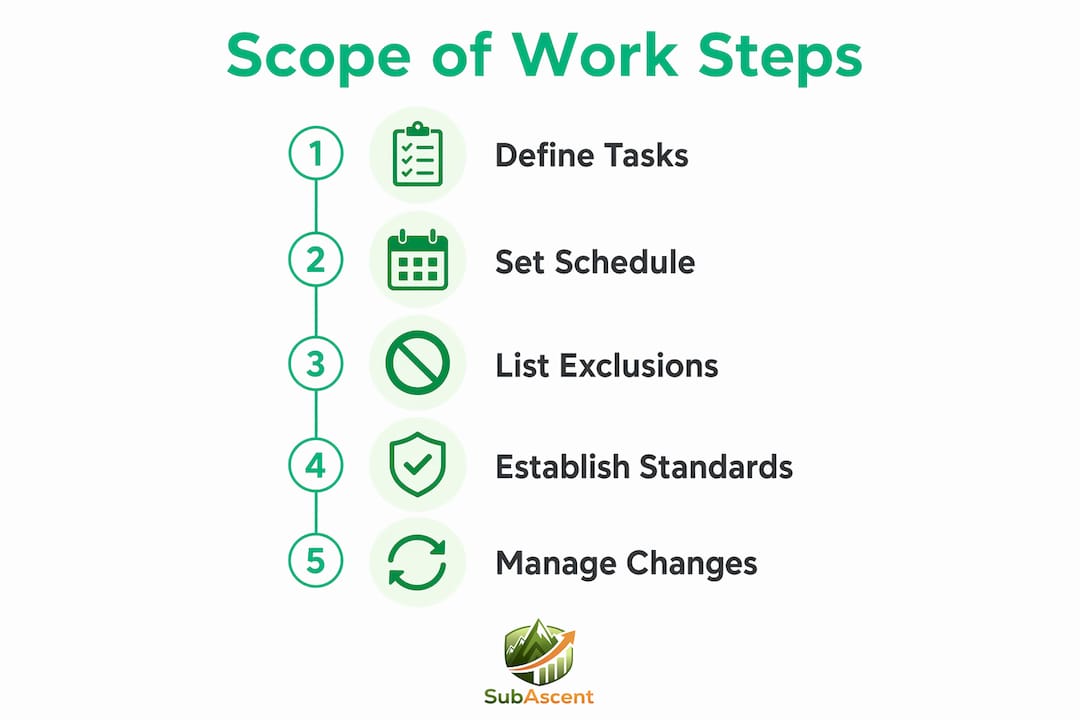
Effective SOWs include four key elements: detailed deliverables, a performance schedule, measurable acceptance standards, and explicit boundary definitions. Miss any one of these, and you create a gap that a dispute will eventually fill.
Here is what each element must contain for a specialty trade sub:
- Detailed deliverables and tasks. List every work item by trade division. For an electrical sub, that means panel schedules, conduit runs, device counts, and fixture types. Vague language like "complete electrical work" is unenforceable.
- Performance schedule and milestones. Tie deliverables to specific dates or project phases. "Rough-in complete before drywall" is a milestone. "Electrical work complete" is not.
- Measurable acceptance criteria. Define what passing looks like. For a concrete sub, that might mean compressive strength test results at 28 days. For a painting sub, it means dry film thickness per coat.
- Explicit inclusions and exclusions. List what you will do and what you will not do. Clearly defining exclusions is the single most effective defense against scope creep. If it is not listed as included, it is excluded. Write that into the document.
- Language standards. Use "shall" for mandatory requirements. Replace "as required" or "per site conditions" with specific references to drawings, specifications, or industry standards like NFPA 70 for electrical or ASTM C94 for concrete.
Pro Tip: Build a standard exclusions list for your trade and paste it into every SOW. For a low-voltage sub, that list might include: no conduit installation, no patching after cable pulls, no UPS equipment. Doing this once saves hours of negotiation on every job.
The performance schedule and measurable standards are the two elements most often left vague. Lacking measurable standards removes your ability to enforce payment milestones. That is not a paperwork problem. That is a cash flow problem.
How does the scope of work differ from a contract or proposal?
The SOW, the contract, and the proposal are three separate documents with three separate jobs. Mixing them up is one of the most common mistakes estimators and project managers make.
- The proposal is a sales document. It describes your general approach, your qualifications, and your price. It is written to win the job. It is not written to govern execution.
- The scope of work is an operational document. It covers the what and when of project delivery. It defines deliverables, tasks, milestones, and boundaries. It does not address payment terms, liability, or dispute resolution procedures.
- The contract is the legal and financial document. It covers payment schedules, retainage, indemnification, insurance requirements, and governing law. For most specialty trade subs, the SOW is attached as an exhibit to the subcontract agreement.
- The project plan is the execution document. It covers how the work gets done: crew assignments, equipment, sequencing, and logistics. The SOW must be finalized before the project plan is built. Reversing that order creates conflicting objectives and rework.
Confusing these documents costs money. An estimator who writes the proposal as if it were the SOW leaves out exclusions, acceptance criteria, and schedule milestones. A project manager who treats the contract as the SOW misses the operational detail needed to manage field execution. Each document has a specific purpose. Use each one for that purpose only.
What is the role of the scope of work in managing changes and preventing disputes?
The SOW is the baseline against which every change order request gets evaluated. When a GC asks your insulation crew to add spray foam to a mechanical room that was not on the original drawings, the SOW is the document that proves the work is new scope. Without that baseline, the conversation becomes a negotiation instead of a fact.
| Scenario | Weak SOW | Strong SOW |
|---|---|---|
| GC requests additional work | No clear baseline; sub absorbs cost | SOW baseline proves new scope; change order issued |
| Payment dispute over milestone | No measurable criteria; GC withholds payment | Acceptance criteria documented; payment enforced |
| Scope creep over project duration | Vague language allows GC to expand work | Explicit exclusions list limits unauthorized expansion |
| Dispute goes to arbitration | Outcome depends on verbal narratives | SOW serves as written evidence of agreed scope |
Vague language in the SOW is the root cause of most disputes. Terms like "as required" or "per site conditions" give the GC room to interpret scope in their favor. That interpretation almost always expands your work without expanding your contract value.
Pro Tip: Treat the SOW as a living document throughout the project. Every approved change order should update the SOW baseline. At project closeout, your SOW should reflect every addition and deletion. That record protects you on final billing and on any warranty claims that follow.
A clear SOW baseline gives you the legal footing to charge for expanded work. Without it, you cannot justify extra charges because there is no agreed starting point to measure against. For a roofing or glazing sub managing multiple GC relationships, that baseline is the difference between a profitable job and one that bleeds margin through untracked extras.
What are best practices for drafting and enforcing the scope of work?
Specialty trade subs who write strong SOWs share a few consistent habits. These practices apply whether you are an electrical estimator building a bid or a plumbing PM managing a $3 million commercial project.
- Use mandatory language. Replace "should" with "shall." Replace "as needed" with a specific quantity, drawing reference, or specification section. Mandatory language like "shall" is what makes the document enforceable in a dispute or claim.
- Write measurable acceptance criteria for every deliverable. "Install fire sprinkler heads" is a task. "Install fire sprinkler heads per NFPA 13, verified by hydrostatic test at 200 psi for two hours" is an enforceable deliverable. The second version protects both parties.
- Build a dedicated exclusions section. Do not bury exclusions in footnotes or proposal qualifications. Put them in a named section of the SOW. For a masonry sub, that section might read: "Excludes waterproofing, flashing installation, and structural steel connections." Explicit exclusions prevent GCs from imposing unbilled work on your crew.
- Align the SOW with your subcontract agreement. Read the subcontract agreement before finalizing the SOW. Conflicts between the two documents create ambiguity that courts and arbitrators resolve against the party who drafted the unclear language.
- Establish a formal change order workflow. Define in the SOW how changes get requested, priced, and approved. Reference your change order documentation process by name. A written workflow prevents verbal approvals that never get paid.
- Review the SOW at every project phase gate. Check the document at rough-in, at inspection, and before final billing. A dynamic SOW that gets updated with each approved change is a project management tool. A static SOW filed away after contract signing is just paper.
The SOW generates alignment across all stakeholders by providing a single source of truth for deliverables and timelines. That alignment reduces miscommunication between your field crew, your office, and the GC's project team. For a flooring or painting sub coordinating with multiple trades on a tight schedule, that shared reference point prevents costly rework.
Key takeaways
A well-drafted scope of work is the single most effective tool a specialty trade subcontractor has to protect project profitability, enforce payment milestones, and defend against scope creep.
| Point | Details |
|---|---|
| SOW is the dispute baseline | Every contract dispute references the SOW to determine what work was included or excluded. |
| Four elements are non-negotiable | Deliverables, schedule, measurable standards, and explicit exclusions must all appear in every SOW. |
| SOW differs from contract and proposal | The SOW covers operational tasks and boundaries; the contract handles legal and financial terms. |
| Mandatory language is enforceable | Use "shall" and specific references to drawings or standards; avoid "as required" or "per site conditions." |
| Treat SOW as a living document | Update the SOW with every approved change order to maintain an accurate project baseline. |
The SOW is the job, not the paperwork
Most of the margin problems I see at specialty trade subs trace back to one root cause: the scope of work was either too vague, never updated, or treated as the GC's document rather than the sub's protection. Estimators spend days building a detailed bid, then hand over a two-paragraph scope that leaves every boundary undefined. That gap is where the money goes.
The misconception I hear most often is that a detailed SOW slows down the bid process. It does not. A well-built SOW template for your trade takes a few hours to create once. After that, you are filling in project-specific details, not starting from scratch. The bid proposal exclusions you write at estimate time become the foundation of your SOW at contract time. The work is already done.
The other mistake is treating the SOW as a static document. Projects change. Drawings get revised. GCs add scope verbally on the jobsite. If those changes do not flow back into a written SOW update and a signed change order, you are working for free. The subs who protect their margin are the ones who treat every verbal request as a trigger for a written scope revision.
— Dave
How Subascent helps trade subs manage scope from bid to closeout

Specialty trade subs, from HVAC and fire protection to concrete and low-voltage, need tools built for the way they actually work. Subascent is built specifically for trade subcontractors managing bids, scopes, change orders, and job profitability without the overhead of GC-focused platforms. The platform supports scope clarity at every stage, from initial bid scope through change order tracking and final billing. If your team is still managing scopes in spreadsheets or buried in email threads, visit Subascent to see how trade-specific tools change the way you run jobs.
FAQ
What is the scope of work definition in construction?
A scope of work is a document that defines the specific tasks, deliverables, milestones, and boundaries of work a subcontractor will perform on a project. It serves as the operational blueprint and the primary reference point in any contract dispute.
Why is the scope of work important for specialty trade subs?
The SOW protects specialty trade subs by establishing a written baseline for payment milestones, change order evaluation, and dispute resolution. Without it, contractors often absorb unplanned costs for work that was never part of the original agreement.
How does a scope of work prevent scope creep?
A SOW prevents scope creep by explicitly listing both inclusions and exclusions, creating legal boundaries around the agreed work. Anything not listed as included is treated as excluded, giving the sub grounds to issue a change order for any additions.
When should the scope of work be finalized?
The SOW must be finalized before the project plan is built. Developing the project plan before the SOW is complete creates conflicting objectives and leads to rework and margin loss during execution.
What language makes a scope of work enforceable?
Using "shall" for mandatory requirements and referencing specific drawings, specification sections, or industry standards makes a SOW enforceable. Vague terms like "as required" or "per site conditions" undermine enforceability and invite disputes.