

Time theft on a trade crew rarely looks like theft. It looks like a foreman rounding everyone to a full eight, a laborer clocked in by a buddy, or two hours of overtime nobody approved. Each one is small. Across 12 people and 50 weeks, it's real money. The fix is not a stricter lecture. It's one person accountable for the crew's time each day, hours coded to jobs, and an approval step before payroll. We built CrewTrack, the free mobile app that comes with every Sub Ascent subscription, around that routine.
TL;DR
- Time theft in the trades is mostly padded hours, buddy punching, early quits and unapproved overtime. Most of it is a process gap, not a bad crew.
- Make the foreman the single point of record for crew time, and have the office approve it before payroll.
- Track crew utilization (job-coded hours divided by paid hours) weekly. A drop tells you where hours are leaking.
- Federal rules require accurate records and pay for all hours worked. Rounding is legal only if it evens out over time.
- Document before you discipline. Firing over disputed hours can turn into a retaliation claim.
Table of Contents
- What time theft looks like on a jobsite
- Honest errors versus theft
- Stop buddy punching without slowing the crew
- Know what the law requires
- Crew overtime controls that work
- Crew utilization rate: the number that shows leaks
- Build the routine: a five-step setup
- Can you fire someone for time theft?
- What we think about it
- Put the routine on one platform
- FAQ
- Sources
What time theft looks like on a jobsite
Office jobs have the clock-in-and-scroll problem. Trade crews have different ones, because the crew is spread across sites, trucks and shops. The common patterns:
- Buddy punching. One worker clocks or texts in for another who is late or absent.
- Padded start and stop times. The crew is on the clock from the shop at 6:30 but doesn't hit the slab until 7:15. Or everyone is logged to 3:30 when the truck left at 3:00.
- Rounding that only goes one way. Every punch gets rounded up. Over a season, that is paid time nobody worked.
- Phantom or misallocated hours. A mason's laborer is coded to the hospital job while actually on a small repair. The payroll is right, the job cost is wrong.
- Unapproved overtime. A crew stays late "to finish up" and the extra hours hit payroll at 1.5x with no one having signed off.
- Drive time claims. Travel between sites and the shop is a gray zone. Set the rule in writing so the claim is not argued after the fact.
Notice that two of those six cost you twice: the wage and the bad job costing that makes your next bid wrong. If an electrical crew's hours land on the wrong job, your estimators learn the wrong labor unit.
Honest errors versus theft
Before you treat a gap as theft, rule out the boring causes. A foreman who writes the crew's hours from memory on Friday will be wrong by 15 or 30 minutes on a good number of entries. That's a system problem. It tends to show up as every entry ending in :00 or :30.
Use these checks to tell the difference:
- Look for patterns, not single days. One 20-minute miss is noise. The same worker, same pattern, three weeks running is a conversation.
- Compare time to the daily report. If the daily report says the crew was on a different floor or a rain delay stopped work at noon, but the time shows a full day, find out why. Our guide on how foremen document delay events shows how to capture those so rain days and waiting on the GC don't look like loafing.
- Compare hours to output. If 4 framers logged 32 hours and the footage installed looks like 16, ask the foreman what happened. Material delays, rework and access problems explain a lot.
- Ask first. Open with "help me understand this entry." You'll learn whether it's a training gap, a bad habit or something worse.
Keep a short note of what you saw, the date and what was said. That note is what protects you if it escalates.
Stop buddy punching without slowing the crew
Buddy punching works because nobody is looking at the clock-in moment. Trade crews make it worse because people arrive at different sites, and a shared shop time clock means nothing for a plumbing crew starting at a school.
The approach that holds up on small crews:
- One accountable submitter per crew. The foreman enters or confirms who is on site and for how long. If a name is on the sheet, the foreman put it there. That alone discourages covering for a buddy, because the foreman is on the hook.
- Entry from the job, same day. Time written at the truck at 3:30 is far more accurate than time reconstructed on Friday. Our post on how foremen track crew hours on the job site covers the daily routine.
- Cross-check against the daily report. The crew list and headcount on the daily report should match the timesheet. A mismatch is the flag.
- Spot checks by the PM. A site visit or a call that asks "who's on today?" takes two minutes and is the oldest anti-buddy-punch tool there is.
CrewTrack is built for this: crew timesheets and daily reports from the field on a mobile app, so the foreman records time on the job and the office sees it without chasing paper. It's free for foremen as part of a Sub Ascent subscription.
Keep it fair. If you tighten rules for the crew, tighten them for the foremen and owners too. Crews notice when the rules only run one direction, and they leave for the shop that pays on time and trusts them.
Know what the law requires
Good time controls are also your protection against wage claims. Here is what the federal rules say, and what they don't.
Overtime. Under the Fair Labor Standards Act, nonexempt employees get at least 1.5 times their regular rate for hours over 40 in a workweek. The federal rule does not generally require overtime just because a day runs past 8 hours or because of weekend work. Your state may be stricter, and some states require daily overtime, so check yours. Union and prevailing-wage jobs often have their own rules too.
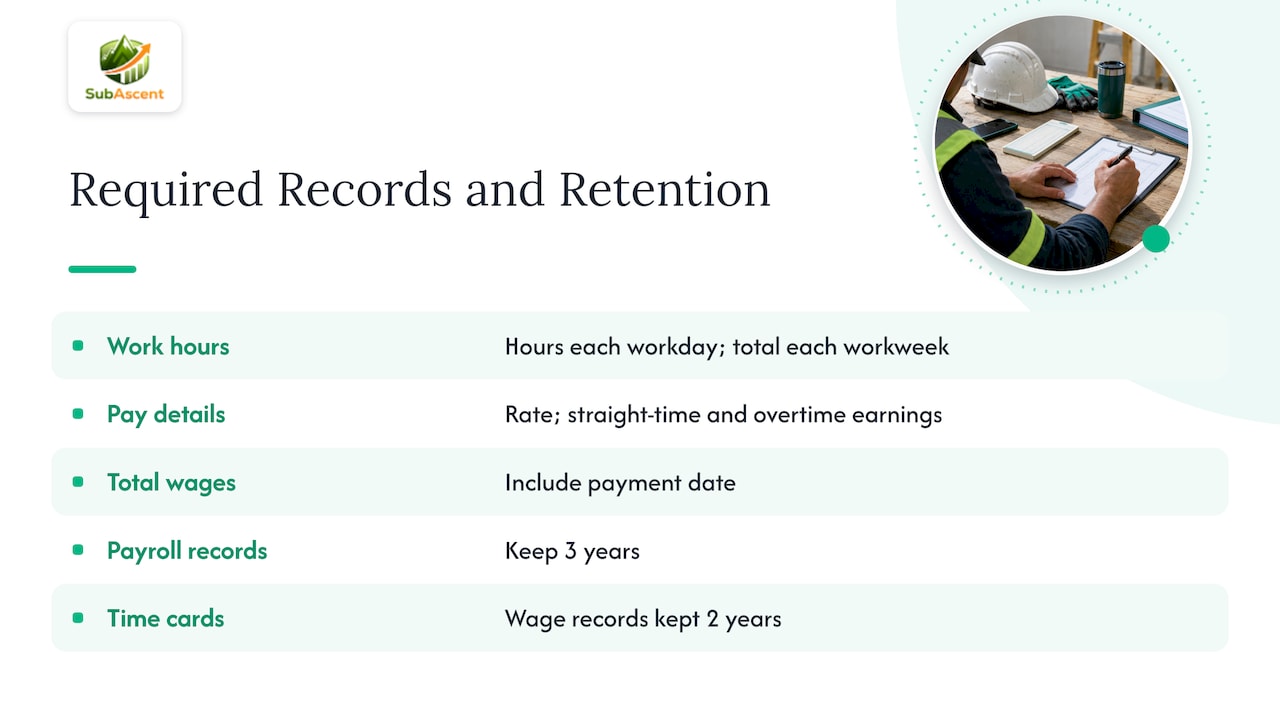
Records. The Department of Labor's recordkeeping fact sheet says you must record hours worked each workday, total hours each workweek, the regular hourly rate, straight-time and overtime earnings, and total wages with the payment date. Payroll records are kept for 3 years, and time cards and wage computation records for 2 years. The same page says no particular method is required. A time clock, a timekeeper or employees writing their own times are all acceptable, as long as the records are complete and accurate.
That last point matters. You don't need fancy hardware to comply. You need accurate records, and a foreman-led digital timesheet gives you a clean, dated record that is easy to produce.
The 7-minute rule. Many crews have heard that you can round to the nearest quarter hour. The rule is that rounding to the nearest 5 minutes, tenth of an hour or quarter hour is acceptable only if, over time, it doesn't result in failure to pay for all time actually worked. If your rounding always favors the company, it fails.
Late clock-outs still count. The DOL gives an example in a hours-worked fact sheet: a $10-an-hour employee scheduled for 40 hours who clocks out 12 minutes late each day is owed one hour of overtime a week. The example comes from health care, but the principle is the same on a jobsite. If someone works the time, you pay it. Your control is approval before the work, not trimming the time afterward.
Crew overtime controls that work
Overtime is where time problems get most expensive, because every hour costs 1.5x. Take a $38 an hour electrician. Overtime is $57. If a 4-person crew picks up 3 extra unapproved hours each, that's 12 hours and $684 in a single week, before payroll taxes and workers' comp. Over 10 weeks, that's $6,840 on a job that may have been bid at straight time.
Controls that keep the hours honest without refusing real work:
- Pre-approval threshold. Foremen can run to 40 hours per person. Anything projected beyond that needs a PM text or tap before it happens. Write it down in one paragraph and hand it to every foreman.
- Mid-week check. On Wednesday, look at hours to date per worker. Anyone at 30 or more gets a plan: finish early, shift a day or approve overtime on purpose.
- Reason codes. Every overtime entry says why: GC schedule push, rework, material late, weather make-up. Over a quarter, those codes show whether overtime is a scheduling problem, a bid problem or a crew problem.
- Approval before payroll. The office reviews and approves timecards before they reach payroll, not after the checks are cut. See our timecard approval workflow for foremen.
- Charge it when it's the GC's doing. If an acceleration or a delay caused the overtime, the time record is your backup for a change order. A clean daily record is the difference between getting paid and eating it.
When the paper trail is clean, you also have the numbers to price the next job right. Our crew productivity tracking guide covers how to use them.
Crew utilization rate: the number that shows leaks
Crew utilization is the share of paid hours that end up coded to a job. Formula:
Utilization = job-coded hours ÷ total paid hours
Example: a 4-person drywall crew is paid 160 hours in a week. Foremen coded 128 hours to jobs. Utilization is 128 ÷ 160 = 80%. The other 32 hours went to shop time, yard work, travel, training, waiting on materials or unknown.
Some of that gap is legitimate. Loading the truck and driving are real work. The point is not to push the number to 100%. The point is to know what's in the gap.
| Utilization pattern | What it usually means | What to do |
|---|---|---|
| Steady at 80-90% for a crew | Normal mix of travel and shop time | Use it as the baseline in your bids |
| Drops for one crew only | Scheduling gaps, a slow job or a foreman issue | Talk to the foreman and PM |
| Drops across all crews | Too much shop time or work backing up behind GCs | Look at your backlog and start dates |
| Paid hours well above coded hours with no notes | Uncoded time, which is where padding hides | Require a job or category code on every hour |
Track it weekly by crew, not by person. Individual numbers invite arguments. Crew numbers start useful ones. Over a few months, your own utilization history is also what makes your labor assumptions in estimates believable, whether you're bidding masonry, concrete or low-voltage.
Build the routine: a five-step setup
- Write the rules on one page. Start and stop definitions (shop, site or truck), the drive time policy, rounding, overtime approval and what happens with errors. Have each foreman sign.
- Make the foreman the record. One submitter per crew, same day, from the job. Digital timecards beat paper because there is nothing to lose, decode or retype. Our post on mobile timecards shows the savings that come from not retyping.
- Code every hour to a job or a category. No uncoded time. Shop, travel and training get their own codes, so the gap is visible instead of hidden.
- Approve before payroll. The PM or office admin reviews exceptions: overtime, odd hours, mismatches with the daily report.
- Review weekly. Utilization by crew, overtime by reason, hours versus budget per job. Fifteen minutes on Monday morning.
Steel and rebar firms with big crews and several sites can see how another trade handles the collection step in our steel contractor timecard guide.
Can you fire someone for time theft?
In most states, employment is at will, so yes, you can end employment for falsifying time. But proving it and doing it cleanly are different things. Before you act, talk to an employment attorney in your state. Here's why documentation matters.
In Betts v. Work Zone Traffic Control, a 2020 Tenth Circuit decision, an employer terminated a supervisor after disputes over his drive-time claims. The court sent his retaliation claim under the FLSA back for a factual dispute over whether the stated reason was a pretext. Among the facts the court weighed: he had claimed drive time the same way for years, and other supervisors were paid for similar claims.
The lesson for a trade firm is practical:
- If you tolerated a practice for years, a sudden firing over it looks selective. Announce the rule, then enforce it for everyone.
- Keep dated records: the time entries, the daily reports, the note of the conversation.
- Apply the same standard to foremen, leads and the office.
- Never dock pay for hours actually worked as a punishment.
A clear written policy and a clean record are what make a termination defensible. They also mean you rarely get to the termination stage, because a worker who knows the numbers are reviewed tends to enter them honestly.
What we think about it
Most of the time theft I've seen in the trades wasn't theft. It was a foreman on Friday night trying to remember who worked where on Tuesday. Then the office keyed in what it could read, and everyone called the result payroll.
That process costs you in two places. You overpay a little on every sheet, and you lose the truth about which jobs make money. If your hours are coded wrong, your next estimate is built on bad labor units.
That's why we built CrewTrack the way we did. Foremen enter crew timesheets and daily reports from their phone on the job. The office approves them. The hours flow into job costing and sync with QuickBooks. It's free for foremen as part of the subscription, because the person who knows the hours should be the one entering them, and it shouldn't cost them a thing.
Fix the routine first. Honest crews get easier to run, and dishonest ones have nowhere to hide.
Dave
Put the routine on one platform
Sub Ascent is job and bid management software for specialty trade subs, including electrical, plumbing, HVAC, masonry, concrete, framing, drywall and roofing. Crew and labor tracking with the CrewTrack mobile app sits alongside estimating, PDF takeoff, submittals, change orders and profit analytics. Plans start at $49 per month for Starter, or $490 per year. Scale is $99 per month or $990 per year, and Pro is $179 per month or $1,790 per year. PDF takeoff is a paid add-on, listed at $99 per month. See the plans and pricing to match one to your crew size.

If timecards are the first thing you want to fix, start with CrewTrack for crew timesheets and daily reports.
FAQ
What counts as time theft on a construction crew?
Any pay for time not worked: buddy punching, padded start or end times, one-way rounding, unapproved overtime and inflated drive time. Wrong job coding isn't theft, but it hides cost and is worth fixing in the same routine.
How do I stop buddy punching on a small crew?
Make the foreman the single submitter of crew time, same day, from the job, and compare the crew list to the daily report. A PM spot check on who is on site adds a second layer. You don't need special hardware, since the DOL does not require any particular timekeeping method as long as records are accurate.
Is the 7-minute rule the law?
Not exactly. Federal rules accept rounding to the nearest 5 minutes, tenth of an hour or quarter hour only if it doesn't underpay employees over time. If your rounding consistently favors the company, it can create back-wage exposure.
Can an employee be terminated for time theft?
Usually yes, but you need a documented rule, dated records and consistent enforcement. Courts have looked closely at whether a stated reason was a pretext when the practice had gone unchallenged for years. Speak with an employment attorney in your state before you act.
Sources
- 29 CFR Part 778, Overtime Compensation (2025)
- DOL Fact Sheet #21: Recordkeeping Requirements under the FLSA
- DOL Fact Sheet #53: Hours Worked
- 29 CFR 785.48, Use of time clocks
- Betts v. Work Zone Traffic Control, Tenth Circuit (2020)