
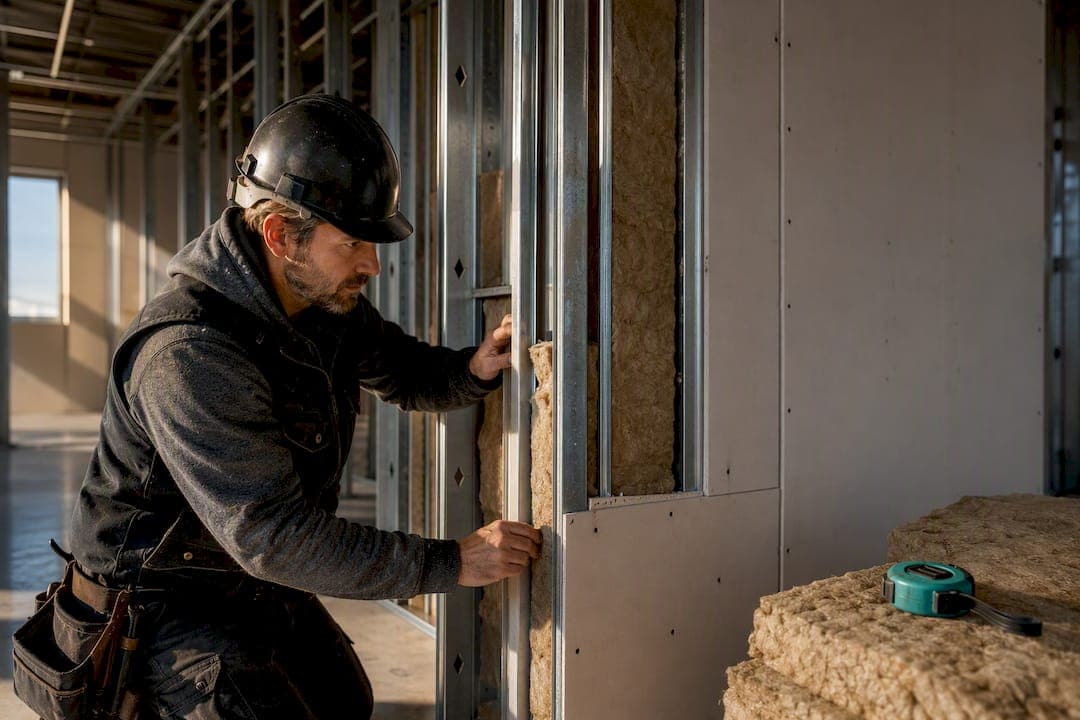
Assembly estimating bundles the materials, labor, and equipment for a repeatable scope into one cost unit priced by a single driver, whether that's linear feet of wall, square feet of roofing, or each rooftop unit. It's the right call when you're bidding design development documents or a fast-turnaround competitive job and need Class 3 or Class 4 accuracy without pricing every stud and screw. For specialty trade subs, the payoff is speed: you measure the driver once and reuse a calibrated rate instead of rebuilding a takeoff from scratch.
TL;DR:
- Assembly rates include material, labor, and equipment costs with embedded productivity assumptions, enabling quick bid turnaround for repetitive systems.
- Accurate measurement of drivers, proper job condition adjustments, and maintaining a calibrated library are essential to prevent costly estimation errors.
- Building a focused, high-frequency assembly library linked to your cost codes ensures reliable estimates and improves bid consistency across projects.
- Over-relying on vendor catalog rates without validation can cause margin issues; ongoing library updates based on actual job data are crucial.
- Use assemblies for design development and routine scopes, switch to detailed takeoffs for high-risk or complex systems, and leverage software like SubAscent for efficiency.
Table of Contents
- What Is Assembly Estimating, Exactly?
- How to Build an Assemblies Estimate Step by Step
- Building an Assembly Library That Actually Pays Off
- Getting the Quantity Drivers Right
- What's Actually Baked Into an Assembly Price
- Sanity Checks Before You Hit Submit
- Assemblies vs. Parametric vs. Detailed: Picking the Right Method
- Where Assembly Estimates Go Wrong
- Why We Switched Our Estimating Workflow to Assemblies
- Let SubAscent Handle the Library Work for You
- Sources
What Is Assembly Estimating, Exactly?
Assembly estimating means pricing a system, like a metal stud partition, a plumbing riser, or a rooftop curb, as one packaged cost per unit of measure instead of listing every component separately. A partition assembly priced per linear foot replaces separate line items for studs, drywall, insulation, and paint with a single bundled rate. That rate already contains a productivity assumption, a labor crew mix, and a material takeoff ratio baked in from historical data.
This sits in the middle of the estimating spectrum. Unit-price estimating still totals individual line items but at least standardizes the pricing. Detailed takeoff prices every component from scratch. Parametric estimating uses a single macro variable like building square footage to swing a rough number. RSMeans positions assemblies as the systems-based method that trades some precision for real speed, best used at design development or for competitive bids where you don't have 100 hours to build a bid.
A few working definitions matter here:
- Driver: the quantity you measure and multiply against the assembly rate (LF, SF, EA).
- Assembly library: your catalog of pre-built, priced systems organized by CSI or Uniformat codes.
- WBS mapping: linking each assembly to a cost code so job costing and estimating speak the same language.
How to Build an Assemblies Estimate Step by Step
Running an assemblies estimate follows a consistent sequence, whether you're bidding a tenant fit-out or a ground-up job. The Gordian assemblies framework, cited in the Fundamentals of Building Construction Management/01%3A_Chapters/1.08%3A_Assemblies_Cost_Estimating) text, organizes this around CSI divisions so estimators can move fast without losing traceability.
- Identify assemblies from the plans. Walk the drawings by CSI division or your own WBS and flag every repeatable system: partitions, conduit runs, duct branches, roof sections.
- Measure the driver. Take off linear feet, square feet, or each count for every flagged assembly, following consistent measurement rules (more on that below).
- Apply the assembly rate. Multiply the driver quantity by your library rate, noting what's included and what's excluded.
- Adjust for job conditions. Override embedded productivity where ceiling height, access, or site congestion differs from your library assumptions.
- Layer in OH&P, escalation, and contingency. Add overhead and profit, material escalation if the job runs long, and a contingency line for design gaps.
- Run a sanity check before you submit. Compare your total against a $/SF or $/LF benchmark from a similar closed job.
Pro Tip: Keep a running tab of every override you make during step 4. If you're adjusting the same assembly the same way on three straight jobs, that's not a job condition anymore. That's a library update you're overdue on.
Building an Assembly Library That Actually Pays Off
A library only earns its keep if it's built around the scopes you bid constantly, not every scope you might someday encounter. An electrical sub might prioritize branch circuit assemblies and panel rough-in; a drywall sub prioritizes partition types by rating and height; a fire protection sub prioritizes sprinkler branch lines by pipe size.
Structure each entry with a unique code tied to your cost codes, so job costing and estimating pull from the same source. Struvia's practical guide on assemblies estimating recommends building the highest-frequency assemblies first, since that's where the time savings compound fastest across bids.
- Assign each assembly a unique code linked to a cost code, not a free-floating description.
- Document the crew mix baked into the rate (for example, 1 foreman and 2 carpenters per 1,000 LF of wall) so labor assumptions stay visible.
- Note inclusions and exclusions explicitly, right in the assembly record, not in a separate memo nobody reads.
- Version each update with a date and the job that triggered the change.
Locking down estimating templates early keeps this from becoming three spreadsheets with three different versions of "truth."
Pro Tip: Start with ten assemblies, not a hundred. A tight, calibrated library beats a bloated one nobody trusts.
Getting the Quantity Drivers Right
Picking the wrong driver, or measuring the right one sloppily, is where assembly estimates quietly go sideways. Walls and partitions typically drive off linear feet of length times height for square footage, or straight LF if your rate already bakes in a standard height. Slabs and roofing drive off square feet, with deductions for openings over a size threshold you set as a rule, not a guess. Doors, rooftop units, and fixtures drive off each (EA) count.
- Deduct door and window openings from wall SF once they exceed a small size threshold, or your library's set threshold.
- Add a waste factor to material-heavy drivers (typically 5 to 10 percent depending on trade and cut complexity).
- Apply a perimeter factor for irregular floor plates instead of a flat rectangular assumption.
- For electrical conduit runs, measure centerline length and add vertical drops separately, not folded into the horizontal run.
- For plumbing risers, count floors served and price by riser, not by total building height.
Masonry crews should apply the same discipline; CMU layout takeoff practices cover deduction rules for block openings that translate directly to assembly-driven wall pricing.
What's Actually Baked Into an Assembly Price
Every assembly rate carries three components stacked together: material cost, labor cost, and equipment cost, with a productivity rate embedded to convert labor hours into a unit price. Sage's estimating documentation notes that when part costs update in the system, assemblies update automatically, which is exactly why keeping the underlying part records current matters as much as the assembly itself.
- Override embedded productivity for site constraints: working above 15 feet, congested urban lots, or occupied-building phasing all slow crews below the library's baseline rate.
- Apply escalation when the job schedule stretches materials pricing past your quote validity window.
- Adjust for location and time, since a rate built from a suburban job three years ago won't hold in a dense downtown bid today.
- Separate what's included in the base rate from what's an allowance, and put that distinction in writing in your bid exclusions.
Sanity Checks Before You Hit Submit
Every assemblies estimate needs a gut check against reality before it goes out the door. Run a $/SF or $/LF comparison against your two or three most similar closed jobs, adjusted for scope and region. If the number is 20 percent off in either direction, something's missing or double-counted.
- Missing mobilization or demobilization costs on a job with tight site access.
- Wrong crew mix for the site conditions (a two-person crew assembly applied to a job that needs three for code clearance).
- No allowance for permit or inspection delays baked into the schedule.
- Scope gaps where the assembly assumed standard finish but the spec calls for premium.
Struvia's guide recommends a firm calibration rule: at close-out, compare actual cost to estimated cost, and if variance exceeds 10 percent on a repeated assembly, that triggers a mandatory library review rather than a shrug.
Assemblies vs. Parametric vs. Detailed: Picking the Right Method
The right method depends on how far along the design is and how much risk you can absorb. Early conceptual pricing with almost no drawings calls for parametric estimating, a rough number off total square footage. Once you've got 50 to 90 percent design development documents, assemblies hit their sweet spot. Once you're at construction documents on a high-risk or unfamiliar scope, drop to a detailed takeoff.
- Design development, competitive bid, familiar scope: use assemblies.
- Conceptual budget, no drawings yet: use parametric.
- Construction documents, unfamiliar system, or heavy MEP coordination: use detailed takeoff.
- Tenant improvement work with repeatable partition types: assemblies almost always win on speed.
- Ground-up structural or complex mechanical: blend assemblies for repetitive scope with detailed pricing for the custom pieces.
The fallback rule is simple: if your assembly variance keeps exceeding your comfort threshold on a given system, stop trusting the library for that scope and go detailed until you rebuild it.
Where Assembly Estimates Go Wrong
The biggest failure mode is treating an assembly like a black box. A practitioner note on model transparency warns that when you don't audit the assumptions baked into a rate, differences in stud spacing, wall height, or finish level quietly wreck your margin without ever showing up as an obvious error.
Trade-specific variance drivers deserve their own line of attention:
- Electrical assemblies rarely account for excessive conduit bends or fire-rated penetrations; price those as adders, not inside the base rate.
- Plumbing assemblies built on straight-run assumptions fall apart on routing around structural obstructions.
- Rebar assemblies often understate lap length and splice hardware on congested reinforcing schedules.
Structure a separate allowance line for unknowns and anticipated owner changes rather than folding a guess into the assembly rate itself.
Pro Tip: If an assembly rate came from a vendor catalog rather than your own job history, treat it as a starting point, not gospel, until you've run it against two real jobs.
Why We Switched Our Estimating Workflow to Assemblies
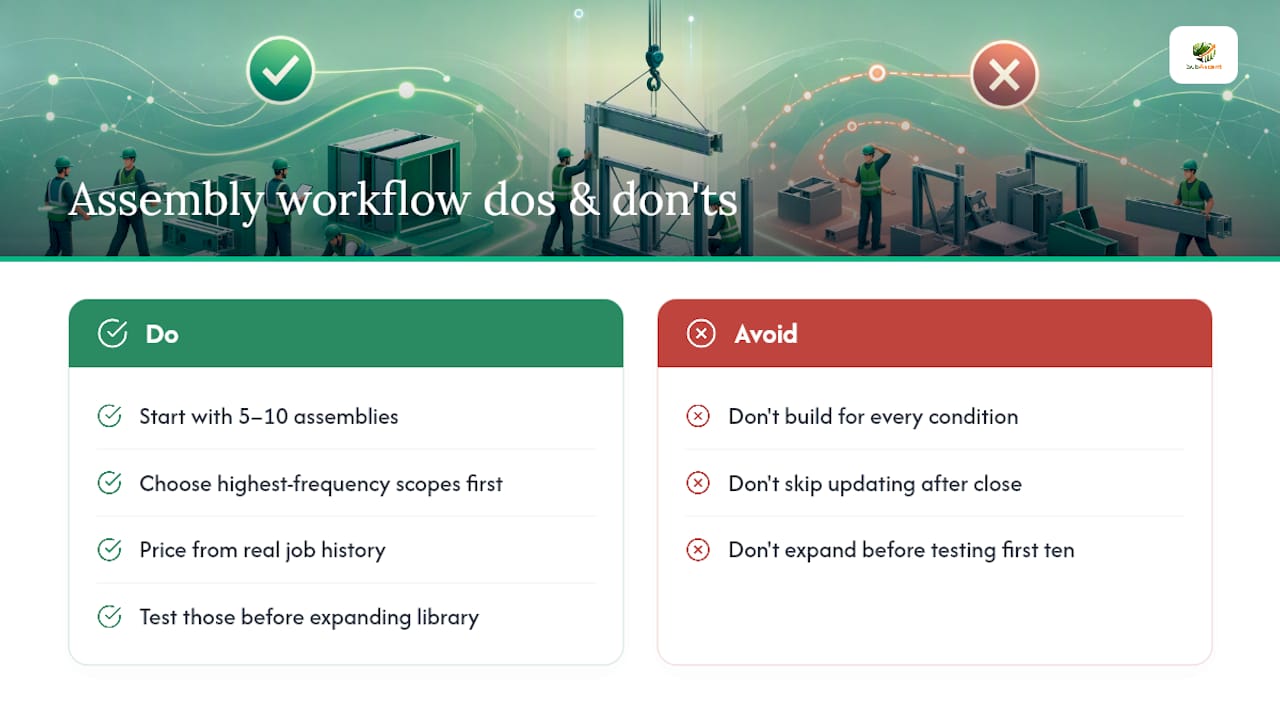
The subs who make the jump to assemblies usually start with one motivation: they're tired of rebuilding the same partition or conduit takeoff for the fifth time this month. The real win shows up in bid velocity, not in some dramatic accuracy leap. Small subs should start with five to ten of their highest-frequency scopes, price them off real job history, and resist the urge to build a library for every possible condition before they've tested the first ten.
The gap between what assemblies promise and what they deliver comes down entirely to whether anyone updates the library after a job closes. Skip that step and the whole method quietly decays.
— Dave
Let SubAscent Handle the Library Work for You
There are software solutions that let specialty trade subcontractors build and maintain their assembly libraries instead of scattering data across multiple spreadsheets. These software solutions typically offer PDF takeoff tools for measuring drivers, bid tracking systems to avoid missing due dates, and QuickBooks synchronization to help integrate close-out actuals into job costing.

If you're still rebuilding the same partition or conduit takeoff every bid cycle, that's exactly the friction this is built to remove. Check out SubAscent and start a free trial to see how it fits your next bid.
Sources
For deeper study, consult the Gordian assemblies framework, RSMeans' estimating methods guide, and the construction software glossary from DesignFlow Build.
- Streamlining construction costs with assemblies: a comprehensive guide — VDCI
- Estimating methods in construction — RSMeans
- Construction assemblies estimating: a step-by-step guide — Struvia