

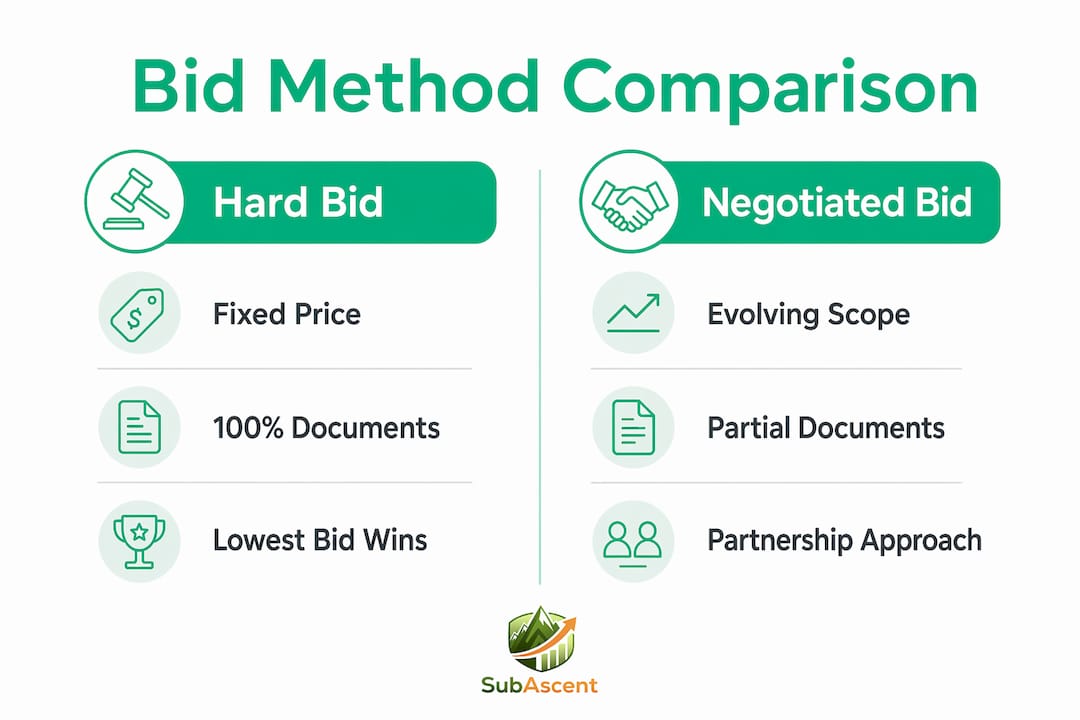
A hard bid is defined as a competitive procurement method where a specialty trade subcontractor submits a fixed price based on 100% complete design documents, and the contract goes to the lowest responsive bidder. A negotiated bid, by contrast, is a collaborative process where the contractor joins the project before the design is finished and works with the owner or general contractor to develop scope and price together. Understanding what is a hard bid versus negotiated is not just academic. It shapes how you staff your estimating department, how you price your work, and which projects you should pursue in the first place.
What is a hard bid versus negotiated in construction?
The procedural gap between these two methods is significant. Hard bids require 100% complete design documents and award to the lowest responsive bidder, typically under AIA A101 stipulated sum terms. Negotiated bids start with partial designs, with contractors acting as consultants, and usually result in a Guaranteed Maximum Price (GMP) or cost-plus contract. That difference in contract type alone changes how you carry risk.
In a hard bid, the scope is locked before you ever touch a pencil. You receive the invitation to bid, pull the drawings, do your takeoff, and submit a number. If you win, you build exactly what was drawn for exactly what you bid. Any gap between your number and reality comes out of your pocket.
In a negotiated bid, the scope evolves. You might get brought in during schematic design, asked to provide budgets at 30% or 60% documents, and then refine your number as the design matures. Your role is closer to a consultant than a price-taker. That is a fundamentally different job.

Pro Tip: Read the solicitation type before you price anything. A hard bid invitation will reference specific bid forms, bond requirements, and a defined bid date. A negotiated solicitation will reference qualifications, references, and a request for your approach. Knowing which you are looking at saves hours of misdirected effort.
The contract type also signals the risk allocation. Fixed lump sum contracts in hard bids put scope risk on the contractor. GMP contracts in negotiated work share that risk, but only if you document your assumptions carefully. Public projects almost exclusively mandate competitive hard bidding due to procurement statutes. Private owners have the flexibility to choose negotiated procurement when they want a trusted partner over the lowest number.
How do bid types affect pricing and project risk?
Pricing strategy differs sharply between the two methods, and getting this wrong is one of the most common ways specialty trade subs lose money.
In a hard bid environment, speed and accuracy are the whole game. You are competing against other electrical, mechanical, or drywall contractors who have the same drawings and the same deadline. Margins are thinner because the owner's goal is the lowest compliant price. The risk is that cheapest bids in hard bid often lead to the most expensive projects due to change orders caused by incomplete scopes or aggressive value engineering. Winning a hard bid at a razor-thin number and then fighting for every change order is a painful way to run a business.
"The lowest bid is rarely the final cost. Owners who chase the cheapest number on a hard bid frequently spend more managing disputes, change orders, and schedule delays than they would have paid for a higher, better-scoped proposal."
Negotiated work carries different risks. The margins are typically better because you are selected on qualifications and relationship, not just price. But negotiated procurement requires transparency with open-book accounting. You cannot pad numbers and hope nobody notices. You must justify every line item, which means your cost data needs to be clean and current.
The four most common pricing mistakes by bid type:
- Underpricing hard bids to win volume. Winning more jobs at bad margins does not fix a margin problem. It accelerates it.
- Failing to carry contingency in negotiated GMP work. When scope is still evolving, you need a buffer for what has not been drawn yet.
- Ignoring escalation in hard bids with long lead times. Material prices for copper wire, PVC conduit, or steel stud can move significantly between bid day and procurement.
- Treating open-book pricing as a weakness. Owners who see clean, well-organized cost breakdowns trust you more, not less.
Pro Tip: On hard bids, build your exclusions list before you build your number. Knowing what you are NOT including is as important as what you are. A tight exclusions list protects you from scope creep after award. Subascent's guide on bid proposal exclusions walks through this in detail.
What skills do subs need for each bidding method?
Hard bid success depends on estimating discipline and strict compliance, while negotiated success depends on collaboration, communication, and design-assist leadership. These are genuinely different skill sets, and most estimating teams are stronger in one than the other.
For hard bids, the core skills are:
- Quantity accuracy. Your takeoff has to be right. An electrical estimator who misses a panel or a plumbing estimator who underestimates fixture counts will lose money before the job starts.
- Speed. Hard bid deadlines are firm. A team that cannot turn a complete bid in the available window will miss opportunities or submit sloppy numbers under pressure.
- Competitive intelligence. Knowing your market, your competitors' tendencies, and which GCs bid shops versus which ones value quality helps you decide where to invest your estimating time.
For negotiated bids, the skill set shifts:
- Preconstruction communication. You need to be comfortable in design meetings, asking clarifying questions, and flagging constructability issues before they become problems.
- Scope documentation. Every conversation about what is or is not included needs to be written down. Scope creep during negotiated preconstruction is common, and undocumented discussions may be assumed included in the GMP.
- Relationship management. Negotiated work is awarded to people the owner trusts. That trust is built over multiple touchpoints, not a single bid submission.
Win rates tell the story clearly. Subcontractors win around 25% of hard bids when well-targeted, versus 40–60% or higher on negotiated work. A 20–25% win rate on hard bids indicates good market fit. On negotiated work, a lower win rate signals a relationship or qualification problem worth addressing.
Pro Tip: Track your bid-to-win ratio by project type, GC, and bid method. If you are winning less than 15% of your hard bids, you are either pricing too high, targeting the wrong GCs, or both. If you are winning less than 40% of negotiated pursuits, your preconstruction value proposition needs work.
When should subs pursue hard bids versus negotiated work?
The right bid method is often decided before you even see the solicitation. Knowing which environment you are walking into helps you allocate your estimating resources correctly.
Hard bids are the standard for:
- Public school, government, and municipal projects where procurement law requires competitive bidding
- Large institutional projects such as hospitals and universities with formal bid procedures
- Projects where the design is fully complete and the owner's priority is price certainty
Negotiated bids are common for:
- Private commercial construction and tenant improvement work
- Projects with aggressive schedules where the owner cannot wait for 100% documents
- Repeat clients who already know your work and want to skip the competitive process
- Design-build and design-assist delivery models
Best-value procurement can blend competitive and negotiated elements, so subs should analyze solicitation scoring carefully rather than assuming price is the only criterion. Some public solicitations score on safety record, past performance, and schedule, not just the bottom number.
| Factor | Hard bid | Negotiated |
|---|---|---|
| Design completeness | 100% complete | Partial, evolving |
| Award basis | Lowest responsive price | Qualifications and relationship |
| Typical contract | Fixed lump sum (AIA A101) | GMP or cost-plus |
| Owner type | Public sector, institutional | Private commercial |
| Margin potential | Thinner, competitive | Higher, relationship-driven |
| Risk profile | Scope locked, change order risk | Scope creep risk if undocumented |
Understanding types of subcontractor bid invitations helps you read solicitation signals faster and decide where your time is best spent.
Key Takeaways
Hard bids and negotiated bids require different skills, pricing strategies, and risk management approaches, and specialty trade subs who recognize this distinction win more work at better margins.
| Point | Details |
|---|---|
| Hard bid definition | Fixed price on 100% complete documents, awarded to the lowest responsive bidder. |
| Negotiated bid definition | Collaborative process starting with partial design, resulting in GMP or cost-plus contracts. |
| Pricing risk differs | Hard bids carry scope risk; negotiated bids carry scope creep risk if conversations go undocumented. |
| Win rates vary | Hard bid win rates average around 25%; negotiated win rates reach 40–60% with strong relationships. |
| Skill sets diverge | Hard bids reward estimating speed and accuracy; negotiated bids reward communication and preconstruction value. |
The mindset shift most subs miss
Most specialty trade subs I have worked with are wired for one method or the other. Electrical and mechanical estimators who grew up in hard bid environments are fast, disciplined, and competitive. They know how to sharpen a number. But put them in a negotiated preconstruction meeting and they freeze, because nobody told them the rules changed.
Moving from a vendor role in hard bids to a partner role in negotiated work requires a real shift in how you show up. In a hard bid, your job ends when you submit the number. In a negotiated pursuit, your job starts there. You are expected to flag design issues, suggest alternatives, and help the owner understand what things actually cost. That is a different kind of confidence.
The mistake I see most often is subs treating negotiated work like a slow hard bid. They wait for the design to get closer to complete before engaging, they submit a number without much context, and they wonder why they did not get selected. The owner chose someone else because that sub was in the room earlier, asking better questions, and building trust before the budget conversation even started.
The other trap is scope creep. I have watched roofing and fire protection subs absorb tens of thousands of dollars in preconstruction work because nobody wrote down what was discussed in design meetings. Document every scope conversation. Send a follow-up email after every meeting that summarizes what was covered and what is still open. That paper trail protects you when the GMP gets set.
Build your pursuit portfolio with both methods in mind. Hard bids keep the pipeline full and the crews busy. Negotiated work builds the relationships that generate repeat business and referrals. The subs who do both well are the ones who grow steadily without chasing every bid that hits their inbox.
— Dave
How Subascent helps subs manage both bid types
Winning on hard bids and negotiated work both start with knowing what is in your pipeline and when things are due.

Subascent is built specifically for specialty trade subs, covering electrical, plumbing, HVAC, drywall, roofing, and more. The platform tracks incoming bid invitations so nothing falls through the cracks, helps you document scope conversations during preconstruction, and keeps your bid history organized so you can analyze your win rates by method and GC. If you are ready to get more disciplined about which bids you chase and how you track them, see what Subascent offers for trade estimating teams.
FAQ
What is the main difference between a hard bid and a negotiated bid?
A hard bid awards the contract to the lowest responsive bidder based on 100% complete documents. A negotiated bid selects a contractor based on qualifications and relationship, with price developed collaboratively as the design evolves.
Which bid type is better for specialty trade subs?
Neither is universally better. Hard bids provide volume and keep crews busy. Negotiated bids offer higher margins and repeat client relationships. A balanced pursuit strategy uses both.
Why do public projects require hard bids?
Public procurement statutes require competitive bidding to protect taxpayer funds and prevent favoritism. Private owners face no such mandate and can choose negotiated procurement freely.
How do I protect myself from scope creep in negotiated work?
Document every preconstruction scope conversation in writing and send a follow-up summary after each design meeting. Undocumented discussions can be assumed included in the GMP, leaving you absorbing unpriced work.
What win rate should I expect on hard bids?
A win rate of 20–25% on well-targeted hard bids indicates a healthy pricing strategy and good market fit. Rates below 15% suggest a pricing or targeting problem worth investigating.