

Managing multiple GC bid portals is the process of handling all bid invitations, submissions, and deadline tracking across different general contractor platforms in one centralized, systematic way. For electrical, plumbing, HVAC, roofing, and other specialty trade firms, this is not a minor administrative task. A missed invitation or a late submission on the wrong portal can cost you a job worth six figures. The industry term for this discipline is bid solicitation management, and the firms that do it well treat it as a core business process, not an afterthought.
What do you need to manage multiple GC bid portals effectively?
The foundation of managing multiple GC bid portals is a single source of truth for every active invitation. Without it, your estimator is checking five different inboxes, three web portals, and a stack of forwarded emails every morning. That is where bids get lost.
Start with these four technology categories:
- Centralized bid log: A shared tracker showing every open invitation, the GC name, the portal it came through, the due date, and the current status. A spreadsheet works at first, but it breaks down fast above 10 active bids.
- Email integration: A system that pulls bid invitations from your inbox automatically, so nothing sits unread in a spam folder.
- Deadline alerts: Calendar-based reminders tied to each bid due date, set at least 72 hours out.
- Document storage: A folder structure that mirrors your bid log, so plans, specs, and addenda are always one click from the bid record.
Beyond technology, you need clean contact data. Stale contact information in GC databases is one of the leading causes of missed invitations. GC platforms flag firms as non-responsive when emails bounce, and those firms quietly stop receiving invites. Audit your firm's contact details on every portal you use at least once per quarter.
| Feature category | Why it matters |
|---|---|
| Bid status visibility | Shows which invites are open, confirmed, or unanswered at a glance |
| Deadline tracking | Prevents missed submissions across multiple portals |
| Document management | Keeps plans, specs, and addenda organized per bid |
| Estimating integration | Eliminates duplicate data entry between bid log and takeoff |
| Accounting sync | Connects awarded bids to job cost tracking without manual re-entry |

Pro Tip: Set a recurring 15-minute Monday morning review of your bid log. Catching a missed invitation early in the week is fixable. Catching it the morning it is due is not.
How do you build a workflow for handling multiple GC bid platforms?
A repeatable workflow is what separates firms that win bids consistently from firms that scramble. The goal is to make every step from invitation to submission predictable, regardless of which GC portal the job came through.
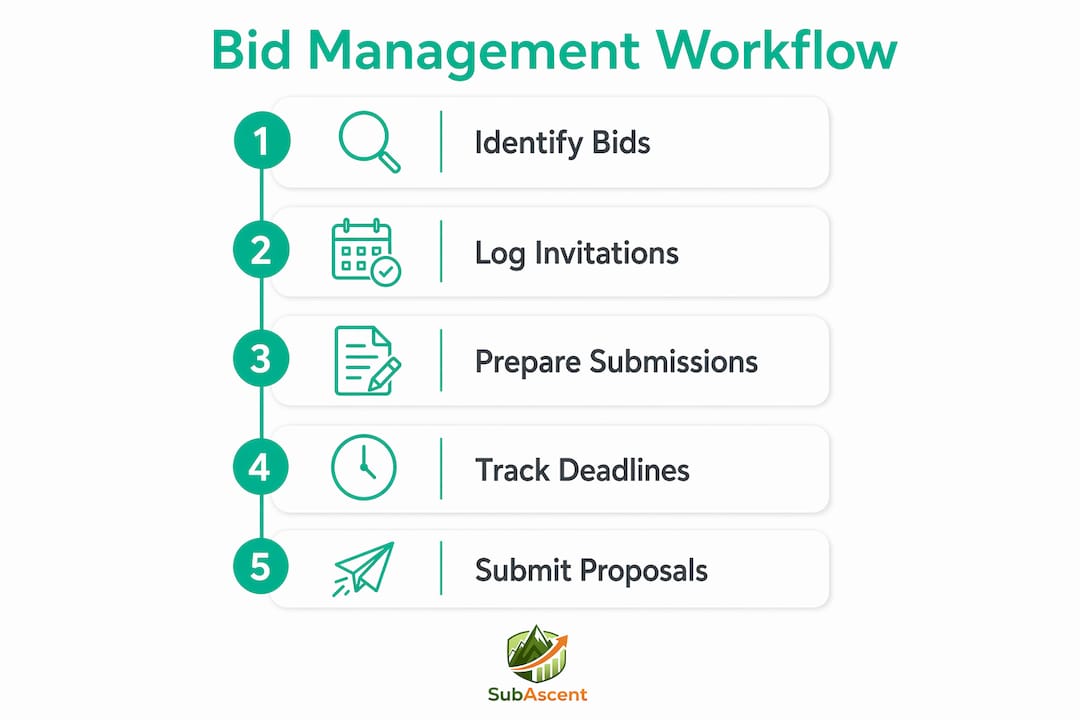
- Log every invitation within 24 hours. The moment a bid invite lands, add it to your centralized log with the portal name, GC contact, project address, trade scope, and due date. Do not wait until you decide whether to bid.
- Qualify the bid within 48 hours. Review the scope, location, and project size. Decide yes or no. If no, decline formally on the portal so the GC sees your response. That keeps your response rate healthy.
- Assign an estimator and pull the documents. Download plans, specs, and the invitation to bid (ITB) immediately. Addenda get issued fast, and you need a baseline to track changes against.
- Run your three-touch follow-up sequence. Send a confirmation email at the midpoint of the bid period. Make a phone call three days before the deadline. Place a backup call 48 hours out if you have not received scope clarification or addenda acknowledgment. This three-touch system keeps your firm visible and your GC relationship active.
- Standardize your submission format. Use a consistent bid cover sheet that includes your firm name, license number, trade scope, exclusions, and clarifications. Standardized ITB templates with customized scope descriptions reduce the back-and-forth that slows down bid leveling on the GC side.
- Submit and confirm. Submit through the portal and follow up with a direct email to the GC estimator. Portal submissions sometimes disappear without confirmation. A direct email creates a paper trail.
- Log the outcome. Whether you win, lose, or get no response, record it. Over time, that data tells you which GCs are worth bidding and which portals produce real work.
Pro Tip: Build a bid package template for each trade scope you bid regularly. A roofing firm bidding TPO replacement jobs should have a standard exclusions list ready to paste. That alone cuts submission time by a third.
Syncing your bid log with your estimating workflow removes a major source of errors. Integration between bid management and estimating software eliminates the duplicate data entry that creates mistakes in scope and pricing. When a bid converts to a job, the project data should flow directly into your cost tracking system without re-keying.
Understanding the types of bid invitations you receive across portals also helps you prioritize. Negotiated invites from repeat GC relationships deserve faster response than cold solicitations from unfamiliar platforms.
How do you troubleshoot common problems with GC bid portals?
Even with a solid workflow, problems surface. Knowing how to fix them fast keeps your pipeline moving.
- Missing invitations: If a GC tells you they sent an invite but you never received it, check your spam folder first, then verify your contact details on their portal. Non-responses often trace back to outdated email addresses or phone numbers in the GC's database, not to a lack of interest. A single phone call to the GC estimator usually resolves it and gets you added back to their list.
- Scope discrepancies across portals: Different GCs format their scopes differently. One portal might list fire protection as a standalone trade; another bundles it with mechanical. Build a scope translation key for your firm so your estimator knows exactly what is and is not included before pricing starts.
- Missed addenda: Addenda issued late in the bid period are a major source of pricing errors. Set a daily check on every active portal during the final week before a deadline. Some portals send email alerts for addenda; others do not. Do not rely on the portal alone.
- Duplicate invitations: Large GCs sometimes send invites through multiple platforms for the same job. Flag duplicates in your bid log immediately. Submitting twice creates confusion and can disqualify you on some portals.
- Bid leveling gaps: Scope gaps in submitted bids are the most common reason GCs push back after bid day. Submit a clear inclusions and exclusions list with every bid. That protects your number and speeds up the GC's comparison process.
Tracking bid due dates across multiple portals is where most firms break down. A centralized system that shows bid status, open rates, and intent at a glance replaces the spreadsheet chaos that causes missed deadlines.
How should mid-size specialty subs approach bid management technology?
The biggest mistake mid-size specialty trade firms make is buying enterprise-level bid management software built for general contractors. Those platforms are designed for firms managing hundreds of subcontractors across dozens of projects simultaneously. For a 15-person electrical or drywall firm, that complexity adds administrative overhead without adding revenue.
Mid-size subcontractors benefit most from lightweight, integrated tools that sync with their existing estimating and accounting workflows. The ROI on enterprise platforms rarely materializes for firms under $15M in annual revenue. The tool should fit the workflow, not force the workflow to fit the tool.
| Approach | Best for | Main drawback |
|---|---|---|
| Manual tracking (spreadsheets) | Firms bidding fewer than 5 jobs per month | Breaks down fast; no alerts or automation |
| Lightweight integrated tools | Mid-size subs, $500K–$15M revenue | Requires discipline to maintain data quality |
| Enterprise platforms | Large GCs or subs with 50+ employees | High cost and complexity for smaller firms |
Evaluate any bid management tool against three criteria. First, does it integrate with your estimating software? Second, does it sync with your accounting system, whether that is QuickBooks or another platform? Third, can your estimator and office manager learn it in a day? If the answer to any of those is no, keep looking.
Construction software built for subs looks different from GC-facing platforms. The best tools for trade firms prioritize bid tracking, deadline alerts, and estimating integration over the project management features that GCs need but subs rarely use.
Pro Tip: Before buying any software, map your current bid workflow on paper. Every step, every handoff, every place where information gets lost. The right tool solves the specific gaps in that map. A tool that solves problems you do not have is just overhead.
Estimating templates are the practical complement to bid management software. When your submission format is already built, the only variable is the scope-specific pricing. That cuts your per-bid time significantly.
Key takeaways
Specialty trade firms that win bids consistently treat bid solicitation management as a defined process, not a reactive task.
| Point | Details |
|---|---|
| Centralize every invitation | Log all bids in one tracker within 24 hours, regardless of which portal they came through. |
| Use a three-touch follow-up | Email at midpoint, call three days out, and call again 48 hours before the deadline. |
| Standardize your submissions | A consistent cover sheet with inclusions and exclusions speeds up GC bid leveling. |
| Audit your contact data quarterly | Stale contact info in GC databases is the top cause of missed invitations. |
| Match tools to your firm size | Lightweight integrated tools outperform enterprise platforms for firms under $15M in revenue. |
What I have learned from watching subs lose bids they should have won
The firms I see struggle with multiple GC bid portals are not losing because they lack estimating skill. They are losing because the invitation never made it to the right person, or the submission went in without a clear exclusions list, or nobody followed up after the bid went quiet. Those are process failures, not technical ones.
The conventional advice is to "get better software." That is usually wrong. A firm that cannot manage five bids in a spreadsheet will not manage them better in a $500-per-month platform. The discipline has to come first. The tool just makes the discipline easier to maintain.
What actually works is treating your bid pipeline the way a sales team treats a CRM. Every invitation is a lead. Every submission is a proposal. Every outcome is data. When you start thinking that way, the process gets tighter fast.
The other thing I would push back on is the idea that you need to bid everything. Response rates on bid invitations run between 30–50% across the industry. GCs expect that. Declining a bid cleanly and quickly is better than submitting a number you are not confident in. Your reputation with a GC is built on the quality of your bids, not the volume.
The firms that master multiple GC bid portals are not the ones with the most software. They are the ones with the clearest process, the most current contact data, and the discipline to follow up every single time.
— Dave
How Subascent supports specialty trade bid management
Specialty trade firms managing bids across multiple GC portals need a system that keeps every invitation visible and every deadline tracked without adding hours of administrative work.
Subascent is built specifically for trade subs, not general contractors. The platform centralizes bid tracking, connects to your estimating workflow, and keeps your submission history organized by GC and project. You can see which bids are open, which are submitted, and which need follow-up, all in one place. For electrical, plumbing, HVAC, roofing, and other specialty trade firms ready to stop losing bids to process gaps, explore Subascent and see how it fits your workflow.
FAQ
What is a GC bid portal?
A GC bid portal is an online platform that general contractors use to send bid invitations, share project documents, and collect proposals from specialty trade subcontractors. Common examples include web-based platforms where subs log in to view scope, download plans, and submit pricing.
How do you track bids across multiple portals?
The most reliable method is a centralized bid log that records every invitation, its source portal, due date, and current status. A centralized tracking system replaces scattered spreadsheets and prevents missed deadlines.
Why am I not getting bid invitations from GCs?
Stale contact information in the GC's database is the most common cause. A direct phone call to the GC estimator often resolves the issue immediately by correcting your contact details and getting you back into their bid cycle.
How many bids should a specialty trade sub submit per month?
The right number depends on your estimating capacity and win rate. Submitting fewer, better-qualified bids consistently outperforms flooding the market with rushed numbers. Track your win rate by GC and portal to find where your time is best spent.
What should every bid submission include?
Every submission should include a cover sheet with your firm name, license number, trade scope, a clear inclusions list, and a written exclusions list. Standardized submission formats reduce scope discrepancies and speed up the GC's bid leveling process.