

Hire a bookkeeper first. That's the short answer for any electrical, plumbing, HVAC, roofing, or masonry sub trying to figure out where to spend money on financial help. Bookkeepers handle day-to-day recording and reconciliation while accountants analyze that data, prepare financial reports, and advise on taxes and strategy. The Bureau of Labor Statistics defines bookkeeping clerks as the people who compute, classify, and record transactions and reconcile accounts. Accountants and auditors, per the BLS, prepare and examine financial records, compute taxes owed, and assess financial operations. The AICPA sets professional standards for CPAs, and IRS Circular 230 governs who can represent your business before the IRS — that's CPAs, enrolled agents, and attorneys, not bookkeepers.
- Hire a bookkeeper first to keep monthly records clean, post job costs, and reconcile bank accounts.
- Add a CPA when you're filing payroll taxes, selecting an entity structure, or facing an IRS notice.
- Use both together as a pipeline: bookkeeper produces clean data; CPA converts it into tax filings, financial statements, and strategic advice.
Key Takeaways
Hire a bookkeeper first for clean monthly records, then add a CPA for tax compliance and strategy — treating them as a pipeline produces better outcomes and lower total professional fees.
| Point | Details |
|---|---|
| Hire bookkeeper first | Monthly reconciliations and job-cost entries are the foundation; add a CPA as tax exposure grows. |
| CPA handles what bookkeepers can't | Tax returns, IRS representation under Circular 230, WIP schedules, and entity strategy require CPA credentials. |
| Clean books cut CPA costs | Reconciled, current books eliminate reconstruction hours and reduce CPA billable time at year-end. |
| Trade-specific experience matters | Require job-costing, retainage, and WIP knowledge from both roles — generic small-business advisors miss too much. |
| Subascent feeds the pipeline | Subascent syncs crew time and job-level field data to QuickBooks, giving bookkeepers and CPAs cleaner inputs. |
Table of Contents
- What is the role of a bookkeeper versus an accountant in trades?
- How each role handles real trade tasks
- What tools and outputs should you expect from each role?
- When should you hire a bookkeeper or accountant?
- How do bookkeepers and accountants work together?
- How to choose and hire the right bookkeeper or accountant
- Practical setup for your trade business
- What most trade subs get wrong about financial roles
- Subascent helps you feed cleaner data into both roles
- Sources
What is the role of a bookkeeper versus an accountant in trades?
The clearest way to see the difference is side by side across the dimensions that actually matter to a trade sub.
| Dimension | Bookkeeper | Accountant / CPA |
|---|---|---|
| Scope | Day-to-day transaction recording and reconciliation | High-level analysis, tax compliance, and financial strategy |
| Core deliverables | Reconciled bank/credit card statements, A/R aging, A/P aging, job-cost entries, payroll files | Adjusted financial statements, tax returns, WIP schedules, profitability forecasts |
| Typical tools | QuickBooks Online/Desktop, payroll platforms (ADP, Gusto), job-costing spreadsheets | QuickBooks (review/adjust), tax software (Drake, UltraTax), audit workpapers |
| Pricing model | Hourly or fixed monthly fee | Hourly or fixed annual engagement |
| When to engage | From day one; monthly cadence | Quarterly review minimum; year-end filing; triggered by IRS notices or financing needs |
| Trade competencies | Job-cost entry by cost code, retainage tracking, certified payroll, change order posting | Job profitability analysis, equipment depreciation schedules, WIP adjustments, entity tax strategy |
A few things worth calling out explicitly:
- Reconciliations belong to the bookkeeper. The CPA reviews them but shouldn't be rebuilding them from scratch.
- P&L preparation starts with the bookkeeper's clean ledger; the CPA adjusts and interprets it.
- Tax returns are the CPA's work, full stop.
- IRS representation requires CPA, enrolled agent, or attorney credentials under Circular 230. A bookkeeper cannot stand in for you at an audit.
- Overlap zone: some experienced bookkeepers produce draft P&Ls and basic job-cost reports. That's fine as a starting point, but those outputs need CPA review before you rely on them for financing or tax planning.
For most specialty trade businesses, the efficient sequence is monthly bookkeeping to keep the ledger healthy, then CPA engagement for annual filings, tax planning, and high-level advice. Hybrid fixed-fee firms that bundle both services under one roof can reduce handoff friction significantly.
How each role handles real trade tasks
Abstract definitions only go so far. Here's how the split plays out on actual trade work.
Change orders: The bookkeeper posts the approved change order amount to the correct job and cost code in QuickBooks. The accountant reviews whether the cumulative change order volume on a job has shifted the profitability picture enough to affect tax planning or bonding capacity.

Retainage: Bookkeepers track retainage receivable as a separate line item so it doesn't inflate current A/R. Accountants review retainage balances on the WIP schedule and factor them into cash-flow projections. Miss this at the bookkeeping level and your CPA is reconstructing months of billings at year-end.

Certified payroll: On prevailing-wage jobs (Davis-Bacon work, for example), the bookkeeper processes payroll at the correct wage rates and generates the certified payroll reports. The accountant confirms the labor burden rates used in job costing are accurate and compliant.
Equipment depreciation: The bookkeeper records equipment purchases and posts monthly depreciation entries per the schedule the CPA sets up. The accountant determines the depreciation method (Section 179, bonus depreciation, MACRS) and updates the schedule annually. For a roofing sub running three lifts and a crane, getting this wrong costs real money. See the equipment costing guide for contractors for a practical breakdown.
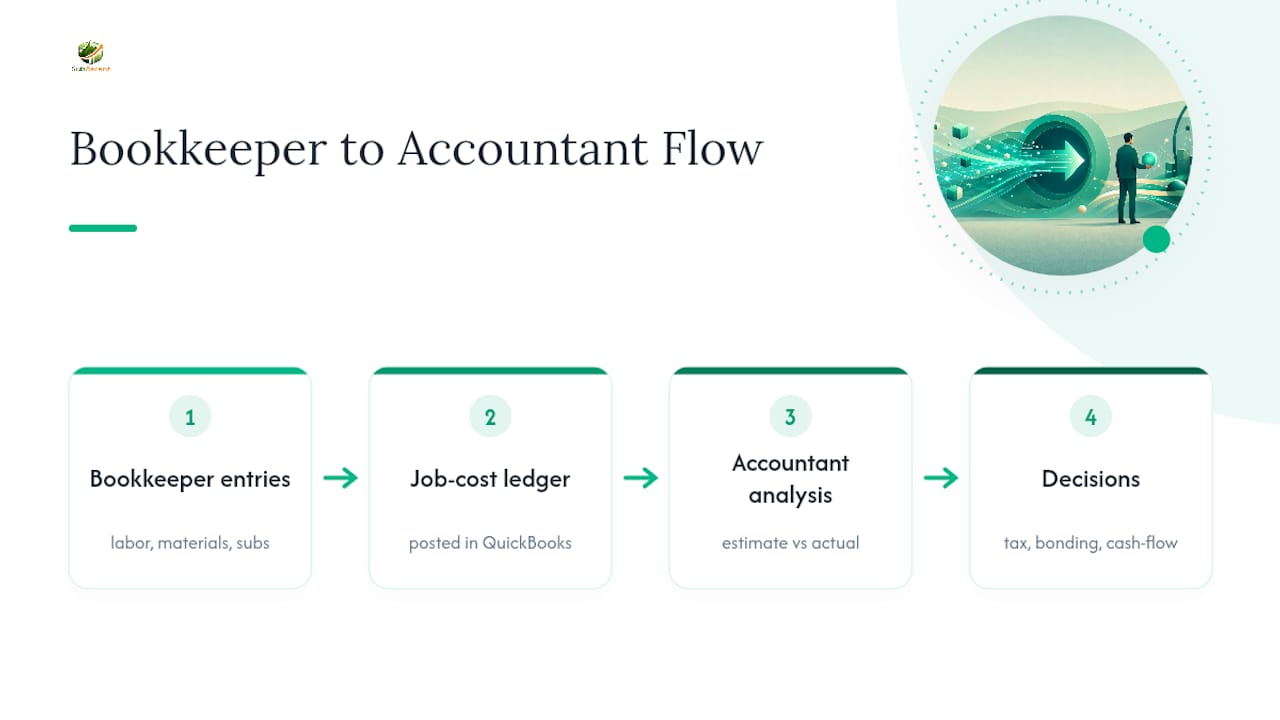
Job profitability: This is where the two roles connect most directly. The bookkeeper posts labor hours, material costs, and subcontract invoices to the correct job accounts throughout the month. The accountant pulls that data to run a job profitability analysis comparing estimated versus actual costs. If the bookkeeper's job-cost entries are sloppy or delayed, the accountant's analysis is worthless.
Delaying accountant involvement until tax season often leads to reconstruction work. A concrete example: an HVAC sub with 15 active jobs and no monthly reconciliations hands their CPA a year's worth of unreconciled transactions in January. The CPA spends 20+ hours reconstructing the ledger before they can even start the tax return. That amounts to a significant expense in billable time that clean monthly bookkeeping would have eliminated.
Trade-specific accountants should understand job costing, equipment depreciation, and retainage accounting. Generic small-business advice misses too much of the construction cycle.
What tools and outputs should you expect from each role?
Bookkeeper outputs (monthly, at minimum):
- Transaction journal with cost codes assigned by job
- Reconciled bank and credit card statements
- A/R aging report (who owes you, how old the invoices are)
- A/P aging report (what you owe and when it's due)
- Job-cost entries posted by labor, materials, subcontract, and equipment
- Payroll processing files and payroll tax deposits
Accountant outputs (quarterly and annually):
- Adjusted financial statements (income statement, balance sheet, cash-flow statement)
- Federal and state tax returns
- Tax provision workpapers
- WIP schedule (work-in-progress) showing over/under billings
- Job profitability analysis and forward-looking forecasts
- Equipment depreciation schedule
Software: QuickBooks Online or Desktop is the standard platform for both roles, with the bookkeeper doing daily/weekly entry and the CPA doing periodic review and adjustment. Payroll runs through platforms like ADP or Gusto. Job-costing accuracy depends on whether labor hours and cost codes flow into QuickBooks cleanly. That's where job costing software for specialty trades adds real value: it connects field data to the general ledger so bookkeepers aren't manually re-entering timecard data.
Pro Tip: Require your bookkeeper to produce a job-cost variance report every month, not just at year-end. Catching it in December is just a post-mortem.
When should you hire a bookkeeper or accountant?
Triggers to hire a bookkeeper:
- Transaction volume has grown past what you can manage in a spreadsheet (typically 50+ transactions per month)
- Payroll has more than two or three employees
- Bank reconciliations are more than 30 days behind
- Job-cost entries aren't being posted, so you don't know which jobs are profitable
- You're spending more than five hours a week on bookkeeping yourself
Triggers to engage a CPA:
- You're hiring W-2 employees and filing payroll taxes for the first time
- You're choosing or changing your entity structure (sole prop to LLC to S-corp)
- You've received an IRS notice
- A GC or lender is asking for compiled or reviewed financial statements
- You're planning a significant equipment purchase and need depreciation strategy
- Annual revenue is approaching a threshold where tax planning has real dollar impact
Suggested cadence: Monthly bookkeeping is the baseline. Add periodic CPA check-ins once you have employees or multiple active jobs. Year-end CPA handoff should happen timely to ensure returns are filed on time without extensions.
Onboarding timeline: A bookkeeper can typically get up to speed on your chart of accounts and job structure in two to four weeks. A CPA engagement takes longer to set up properly — expect four to six weeks to establish the scope, gather prior-year returns, and align on deliverables — so don't wait until March to start that conversation.
Most CPAs won't do routine monthly reconciliations or weekly A/P entry. Hiring a CPA for that work means paying significantly higher hourly rates for tasks a bookkeeper handles more affordably. The math doesn't work.
How do bookkeepers and accountants work together?
The pipeline runs from the jobsite to the bookkeeper to the accountant. Here's how to structure it so nothing falls through the gaps.
- Daily field capture: Foremen submit timecards with job numbers and cost codes. Change orders get approved and logged. Material receipts are photographed and forwarded.
- Weekly bookkeeper entry: Transactions post to the correct job accounts. Payroll runs. Vendor invoices get coded and entered into A/P.
- Month-end close (bookkeeper): Bank and credit card reconciliations complete. A/R and A/P aging reviewed. Job-cost entries verified against field reports. Payroll reconciled to tax deposits.
- Month-end deliverables to CPA: Clean general ledger export, reconciliation backup, job-cost summary by job, and any outstanding retainage or change order documentation.
- Quarterly CPA review: Accountant reviews adjusted financials, checks WIP schedule, flags any tax planning items, and confirms depreciation entries are current.
- Year-end handoff: Full reconciliation package, payroll summaries, fixed asset schedule, and prior-year comparison delivered to CPA by January 15.
Pro Tip: Set up a shared folder (Google Drive or Dropbox) with a standardized structure: one subfolder per month, containing reconciliations, bank statements, payroll summaries, and job-cost backup. Your CPA can pull what they need without a back-and-forth email chain. That alone cuts CPA reconstruction hours.
The job costing setup checklist for small trade firms walks through how to configure QuickBooks job accounts so the bookkeeper's entries feed directly into the reports your accountant needs.
How to choose and hire the right bookkeeper or accountant
Interview questions for bookkeepers
- Which version of QuickBooks do you use, and have you set up job costing in it?
- How do you handle retainage receivable — do you track it separately from current A/R?
- What's your reconciliation cadence, and how do you document it?
- Have you processed certified payroll for prevailing-wage jobs?
- How do you handle cost codes when a job has multiple phases?
Interview questions for accountants / CPAs
- What percentage of your clients are in construction or specialty trades?
- Are you credentialed to represent clients before the IRS under Circular 230?
- How do you handle WIP schedules and over/under billing adjustments?
- What's your advisory cadence — do you do quarterly check-ins or only year-end?
- Will you accept books prepared by a third-party bookkeeper, or do you require your own?
Red flags
- A bookkeeper who claims they can prepare your tax return or represent you at an IRS audit.
- A CPA who insists on doing your monthly reconciliations themselves (you'll pay CPA rates for bookkeeper work).
- Either role with no construction or trade experience — generic small-business advice misses job costing, retainage, and WIP entirely.
- Vague pricing with no defined scope of work.
- Reluctance to share deliverables in a format your other advisor can use.
Sample scope-of-work checklist
- Frequency: Monthly close by the 10th of the following month
- Deliverables: Reconciled statements, A/R and A/P aging, job-cost summary, payroll reconciliation
- Access: Read/write access to QuickBooks; view access to bank accounts
- Backup: Monthly folder delivered to shared drive by close date
- Communication: Monthly summary email; escalation protocol for IRS notices or large variances
- Pricing: Fixed monthly fee preferred over hourly for bookkeeping; hourly or fixed annual for CPA
Practical setup for your trade business
Getting the structure right from the start saves months of cleanup later.
- Clean up the bank reconciliations first. Before anything else, reconcile every account back to a clean starting point. Unreconciled transactions make every downstream report unreliable.
- Adjust your chart of accounts for trades. Separate income accounts by job type (commercial electrical, service work, T&M). Separate cost accounts for materials, labor, labor burden, subcontract costs, and equipment. See why subs need separate job accounts for the logic behind this structure.
- Set up a job account for every active project. Each job gets its own income and cost tracking. Retainage receivable posts to a separate retainage account, not the main A/R.
- Sync crew time to cost codes. Labor is typically the largest cost variable on a trade job. If timecards aren't hitting the right cost codes, your job-cost reports are fiction.
Month-end checklist:
- Bank and credit card reconciliations complete
- A/R aging reviewed; overdue invoices flagged for follow-up
- A/P aging reviewed; upcoming due dates confirmed
- WIP/job-cost variance checked against estimates
- Payroll reconciled to tax deposits
- Equipment depreciation schedule updated
Pro Tip: When you set up retainage, create a separate QuickBooks account called "Retainage Receivable" and a corresponding "Retainage Payable" for amounts you hold on subs. Mixing retainage into regular A/R inflates your current receivables and makes cash-flow projections unreliable. Your CPA will thank you.
Clean books reduce CPA billable hours directly. When bookkeeping is current and reconciled, CPA work is faster and cheaper because there's no reconstruction phase. For a trade sub billing $2M–$5M annually, that difference can be $2,000–$5,000 per year in CPA fees alone.
What most trade subs get wrong about financial roles
The mistake isn't hiring the wrong person. It's treating bookkeeping and accounting as the same job and then assigning both to whoever is cheapest or most available.
A plumbing sub owner who does their own QuickBooks entry on Sunday nights isn't doing bookkeeping. They're doing data entry without a system. The entries are inconsistent, cost codes are wrong, and by the time the CPA sees it, the job-cost data is useless for anything except filing a return. The CPA charges extra to sort it out, and the owner still doesn't know which jobs made money.
The fix is sequencing. Hire a bookkeeper with trade experience first. Get monthly reconciliations running and job-cost entries posting correctly. Then bring in a CPA who understands construction — one who will review WIP, advise on depreciation strategy, and tell you whether your S-corp election is actually saving you money. That sequence produces something valuable: a ledger that tells you, mid-job, whether you're on track or bleeding margin.
The other mistake is waiting. Trade owners often delay CPA involvement until tax season, then hand over a year of chaos. That's not a tax strategy. It's a reconstruction project billed at CPA rates.
Subascent helps you feed cleaner data into both roles
The gap between jobsite activity and your bookkeeper's QuickBooks entries is where job-cost accuracy breaks down. Foremen forget to submit timecards. Change orders get approved verbally and never posted. Material receipts pile up in a truck cab.

Subascent captures crew time, change orders, and job-level field data in real time and syncs it directly to QuickBooks. Your bookkeeper gets clean, coded entries instead of a stack of paper to sort through. Your CPA gets a ledger that actually reflects what happened on each job. The platform doesn't replace your bookkeeper or accountant. It feeds them better data so both roles cost you less and produce more. If you're running electrical, HVAC, roofing, or any other specialty trade and your job-cost entries are always a month behind, see how Subascent works and start a free trial.
Sources
- Bookkeeping, Accounting, and Auditing Clerks : Occupational Outlook Handbook: : U.S. Bureau of Labor Statistics
- Bookkeeper vs Accountant vs CPA — Everstone CPA
- Bookkeeper vs Accountant: Who to Hire First in 2026? — Catalyst CPA
- Bookkeeper vs. Accountant: A Career Comparison — QuickBooks
This article is general information, not a substitute for advice from a qualified financial advisor. Consult a qualified financial professional about your own circumstances before acting on anything here.