

Start at the table of contents, then read Division 00 and Division 01 completely. That's where the contract rules, liquidated damages, testing obligations, and submittal deadlines live, and it's where most bid busts start. Everything else in the spec book gets prioritized by how much it touches your trade. Skim technical divisions outside your scope; read yours line by line.
TL;DR:
- Reviewing Division 00 and Division 01 thoroughly before scanning technical divisions ensures key contractual and risk-related issues are identified early.
- Most specifications follow CSI MasterFormat, and understanding its structure allows quick navigation of large manuals, especially divisions relevant to your trade.
- Focus on Part 2 and Part 3 in each section as checklists to identify material requirements and installation details that impact bids and schedules directly.
- Document all conflicts, ambiguities, and scope gaps during spec review to prevent costly change orders and to clarify responsibilities with owners and other trades.
- Using tools like scope-gap logs, AI-assisted PDF search, and structured workflows accelerates spec reading and reduces the chance of missing critical clauses that affect project cost and risk.
Table of Contents
- What Is Spec Book Reading and Why Does It Matter?
- How Are Spec Books Organized? Understanding MasterFormat
- What Is the Best Order to Read a Spec Book In?
- What Should Trade Subs Check in Their Division?
- How Do You Handle Conflicts Between Specs and Drawings?
- What Tools and Shortcuts Speed Up Spec Reading?
- Why Estimators Still Miss the Clause That Costs Them
- A Faster Way to Track What You Find in the Spec Book
- Standards and Guides Worth Keeping on Hand
- Sources
What Is Spec Book Reading and Why Does It Matter?
Spec book reading is the process of working through a project manual (the bound or digital document that pairs with the drawings) to find every requirement that affects your price, your schedule, and your legal exposure on a job. The drawings show you where things go. The spec book tells you what they're made of, how they get tested, who inspects them, and what happens if you're late.
Most subs treat the spec book as a reference to check later. That's backwards. The project manual usually governs quality and process, and in most contracts it takes precedence over the drawings when the two conflict on a materials or workmanship question. Miss a clause in Division 09 about paint mockups or Division 07 about roofing warranties, and you've bid a different job than the one you'll actually build.
Format matters more than people admit. A printed, coil-bound manual forces linear reading, which is slow but hard to skip pages on. A searchable PDF lets you jump straight to your division, but it's easy to miss general requirements buried in Division 01 if you only search your trade name. Know what you're working with before you decide how to attack it:
- Print or coil-bound: read cover to cover, tab as you go, expect no search function.
- Native PDF: text is searchable, ideal for keyword scanning across divisions.
- Scanned PDF: often not searchable without OCR, so budget extra time or run it through a PDF tool first.
The Stack Overflow Engineering blog notes that well-built technical specification documents follow a predictable structure: front matter, context, requirements, and evaluation criteria. Construction spec books follow the same logic, just dressed up in CSI formatting.
How Are Spec Books Organized? Understanding MasterFormat
Nearly every commercial spec book in the US follows CSI MasterFormat, a numbering system that groups requirements into 49 divisions, from Division 00 (Procurement and Contracting) through Division 49 (specialty equipment). Once you know the pattern, you can navigate a 1,500 page manual almost as fast as flipping to a bookmark.
Each division breaks into numbered sections. Electrical work usually falls under Division 26, plumbing under Division 22, HVAC under Division 23, masonry under Division 04, and finishes scattered across Divisions 06 through 09. If a project manual deviates from that numbering (some smaller architects still write proprietary formats), flag it immediately. It usually means the spec author copied sections from an older project and the cross-references won't line up cleanly.
Within each section, look for the three-part format:
- Part 1, General: submittal requirements, quality assurance, warranty terms, and references to industry standards.
- Part 2, Products: manufacturer names, model numbers, material specifications, acceptable substitutions.
- Part 3, Execution: installation methods, tolerances, testing, and closeout procedures.
Treat Part 2 and Part 3 as checklists, not prose. Every sentence in those sections is a line item that either belongs in your estimate or needs a clarification before bid day. Use the table of contents and the section index at the front of the manual to jump directly to your divisions instead of paging through the whole document looking for your trade.
What Is the Best Order to Read a Spec Book In?
Reading a spec book front to back wastes time you don't have during a bid cycle. A structured sequence gets you to the expensive stuff first and leaves technical scanning for last.
- Scan the table of contents. Confirm which divisions and sections exist, note anything unusual or missing, and flag sections that reference your trade even under an unexpected division number.
- Read Division 00 in full. This covers bidding procedures, contract form, bonding, insurance, and often liquidated damages language.
- Read Division 01 in full. General Requirements sets the rules everyone on the job has to follow: submittal procedures, testing and commissioning requirements, allowances, temporary facilities, and closeout obligations.
- Prioritize technical divisions by exposure. Read your own division word for word. Skim adjacent divisions that touch your scope (mechanical reading electrical coordination clauses, for example). Skip divisions with zero overlap.
- Build a scope-gap log as you go. Every ambiguous clause, missing detail, or conflict gets a line item, not a mental note.
- Schedule a re-check for addenda. Late-issued addenda routinely change Division 01 requirements after you've already read it once.
Division 01 is where estimators lose money without realizing it; understanding detailed shop drawings production and bar bending schedule for construction projects can help prevent costly mistakes. Watch specifically for liquidated damages amounts and how they're triggered, testing and commissioning scope that isn't in anyone's obvious trade, allowances that shift risk onto the sub, submittal sequencing that requires long lead times you haven't budgeted, and temporary utility or protection requirements assigned to trades by default.
Pro Tip: If you're bidding three or four jobs in the same week, split the reading by division type instead of by project. Have one estimator read every Division 01 across all active bids in one sitting. The repetition makes inconsistent liquidated damages clauses and odd commissioning requirements jump out fast.
On multiple pursuits with a small team, triage by deadline and dollar value first, then assign Division 00/01 to your most experienced estimator (that's where the legal risk concentrates) and split technical divisions among whoever has the fastest read speed on that trade.
What Should Trade Subs Check in Their Division?
Generic spec-reading advice misses the details that actually move your number. Here's what to look for by trade.
Electricians should treat Division 26 as the real bid document, not the one-line panel schedule on the drawings. According to guidance on reading construction spec books, specifications typically govern quality standards while drawings govern layout and quantity, so a mismatch between an electrical drawing and the Division 26 manufacturer list gets resolved in the spec's favor more often than not. Check approved manufacturer lists, panel schedules buried in Part 2, testing and megger requirements in Part 3, and coordination clauses that assign conduit routing responsibility to another trade.

HVAC and mechanical estimators need to separate performance requirements from prescriptive ones. A performance spec says "deliver 400 CFM at a sound level under 35 NC," and leaves you to pick the equipment. A prescriptive spec names the exact unit and model. Performance specs carry more design risk and usually more margin opportunity; prescriptive specs are easier to price but leave no room to substitute for cost savings. Also check commissioning scope and temporary heat or cooling obligations during construction, which frequently land on the mechanical sub by default language in Division 01.
Plumbing, masonry, concrete, and finish trades share a common blind spot: QA/QC and closeout sections. Mockup requirements (a masonry sample panel, a paint finish sample) can add real labor and schedule time if you don't price them. Warranty periods that extend past the standard one year, especially on roofing and waterproofing, change your risk exposure. Closeout documentation, from as-builts to O&M manuals, is often unpriced because nobody read that far into Division 01.
Across every trade, note interface items: work that touches two scopes, like an electrician setting anchors for someone else's equipment or a mason coordinating with structural steel. These create most change-order disputes because both subs assumed the other one owned the item.
How Do You Handle Conflicts Between Specs and Drawings?
Conflicts between the spec book and drawings happen on nearly every project. What separates a clean resolution from a change-order fight is whether you documented the conflict before you started work.
- Find the order of precedence clause. It's usually in Division 01 or the general conditions. Most contracts state specifications govern over drawings for quality and material questions, while drawings govern for quantity and location. If the contract is silent, that's the industry default, but don't assume it. Confirm it in writing.
- Issue an RFI when a conflict actually affects price or schedule. Word it factually: state the drawing reference, the spec section, the discrepancy, and ask a specific question. Vague RFIs get vague answers that don't protect you later.
- Follow the formal substitution process. Division 01 typically sets a deadline for substitution requests, often tied to the bid date or a set number of days into the contract. Submitting a substitution after that window, even a better one, gives the GC grounds to reject it outright.
- Document owner-furnished equipment separately. Specs often list equipment the owner supplies but the sub installs. Get the installation responsibilities, delivery schedule, and any warranty split in writing before you price the connection work.
Submittals tie directly into this. Every submittal should reference the exact spec section it responds to; generic submittals get rejected and cost you a resubmission cycle you didn't schedule for. If you want a deeper walkthrough of the submittal and approval sequence, see how to review shop drawings for masonry submittals or a broader submittals workflow guide for subs working with general contractors.
What Tools and Shortcuts Speed Up Spec Reading?
A repeatable system beats individual willpower. Here's a compact checklist and a couple of tools that make the workflow faster instead of just longer.
Division 01 costly-miss checklist:
- Liquidated damages amount and trigger conditions
- Commissioning and testing scope not obviously tied to one trade
- Allowances that shift undefined scope onto the sub
- Submittal review timelines and resubmission penalties
- Temporary utilities, protection, and cleanup assignments
Scope-gap log fields: spec section, drawing reference, description of the conflict or gap, dollar impact if known, status (open, RFI sent, resolved), and owner. Two example rows: "Div 09 91 00, Section 3.2 vs. Sheet A601: paint spec requires three-coat system, drawing schedule shows two coats. RFI sent 3/4." and "Div 26 05 19, wire sizing table missing for feeder runs over 200 feet. Flagged for clarification before bid."
Search PDFs using phrases, not single words. Try "furnished by," "by others," "not in contract," and "coordinate with" to surface interface items fast. AI-assisted document search can cut review time significantly. According to Provision's estimating research, a large healthcare spec manual is common, and manual review of that volume can take many hours, but structured or AI-assisted workflows can reduce the time substantially.
Assign reading by strength, not seniority alone. Your fastest reader takes Division 01 across every active bid. Whoever knows your trade's Part 2 language best takes the technical sections. Hand off priced items to the estimator building the number, not the one who read the clause.
Why Estimators Still Miss the Clause That Costs Them
I've watched a mechanical sub eat a five-figure loss because a commissioning requirement sat in Division 01, not Division 23, and nobody read the general requirements past the bid bond section. I've also seen a masonry crew get blindsided by a mockup and sample panel requirement that added two weeks nobody scheduled for, because it lived in a QA paragraph three pages after the material spec everyone actually read.
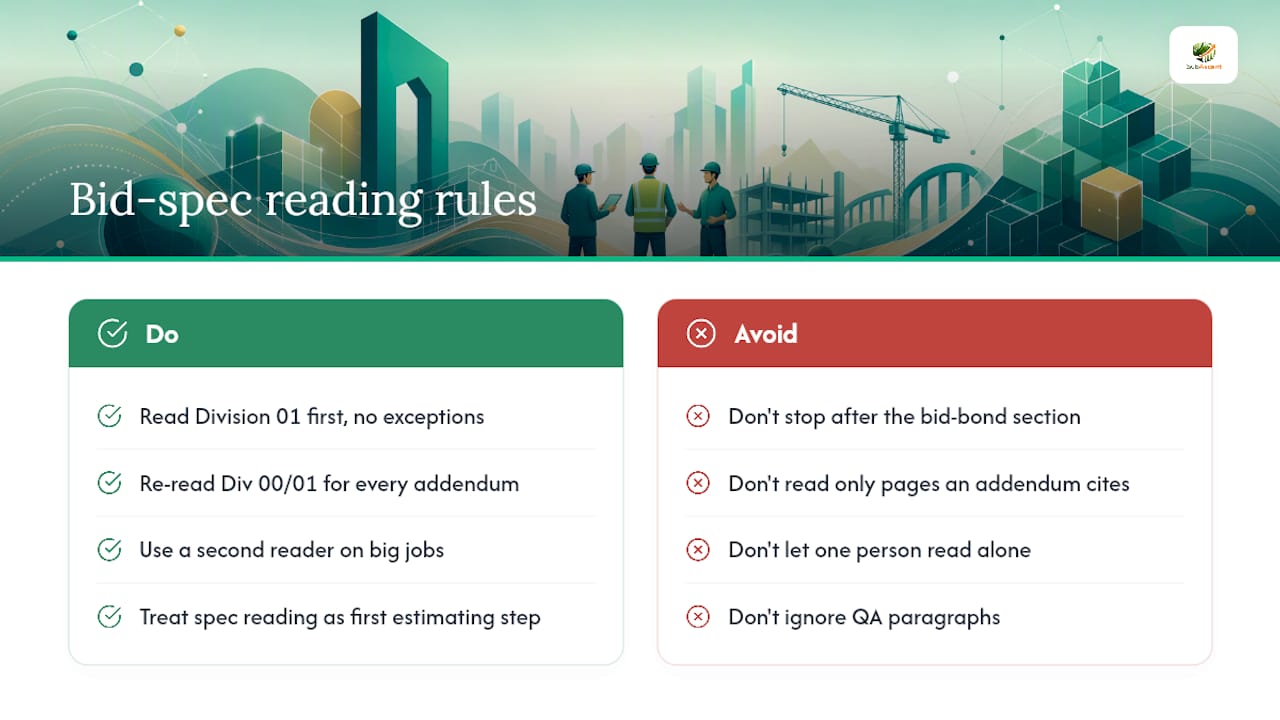
Three rules-of-thumb for tight bid schedules: read Division 01 before anything else, no exceptions, even when the bid closes in 48 hours. Treat every addendum as a mandatory re-read of Division 00 and 01, not just the pages it references. And never let one person read the entire spec book alone on a job over a few million dollars. A second set of eyes on Division 01 catches what fatigue misses.
This isn't separate from estimating and takeoff work. It's the first step of it. A number built on an incomplete read of the spec book is a guess with a decimal point.
— Dave
A Faster Way to Track What You Find in the Spec Book
Subascent gives you somewhere to put everything you flag while reading, instead of losing it in a margin note or a Slack thread nobody reopens. You still read Division 00 and 01 the same way. The difference is what happens after: your scope-gap log, submittal tracking, and bid details live in one place tied to the actual pursuit, so nothing gets lost between the estimator who read the spec and the PM who has to execute it later.

If you're piecing together spreadsheets, PDF annotations, and email threads to manage what a spec book throws at you across five open bids, that's exactly the gap Subascent's bid and job management platform is built to close. It's one option among several, not the only way to run an estimating desk, but it's built specifically for trade subs rather than adapted from general contractor software. Start a trial and load your next active bid to see how the scope log holds up against a real spec book.
Standards and Guides Worth Keeping on Hand
Keep CSI MasterFormat's standards overview bookmarked. It's the numbering backbone behind almost every commercial spec book you'll open, and knowing the division structure cold saves real time on every bid.
When a spec references code compliance, verify it against the International Code Council, not the spec author's summary of the code. Summaries get outdated; the code itself doesn't.
For a book-length reference, Print and Specifications Reading for Construction is a solid training resource for newer estimators learning to read drawings and specs together rather than in isolation.
Sources
- CSI resources — standards overview
- Spec Reading for Estimators: How to Get Through a 2,000-Page Spec Book | Provision
- How to Read and Interpret a Construction Spec Book - ExpertCE
- A practical guide to writing technical specs — Stack Overflow Blog
- Print and Specifications Reading for Construction, Updated Edition — Wiley