

For specialty subcontractors, a trade certification is a license or credential that proves legal authority, technical competency, or safety compliance — and it directly determines whether you can bid, prequalify, get bonded, and put crews on-site. This is not about vocational training or trade school diplomas. It's about the specific documents GCs check before they hand you a bid invitation.
Here's what's at stake when your credentials are current, complete, and organized:
- Bid eligibility: An expired state contractor license can disqualify your bid before anyone reads your number.
- Prequalification scoring: GCs use prequalification forms to confirm licenses, insurance, bonding, safety records, and project experience before inviting subs to bid.
- Insurance and bonding impact: Your OSHA EMR and safety record directly affect your insurance premium and bonding capacity.
- On-site crew proof: OSHA 10/30 cards, journeyman licenses, and manufacturer training records are checked during audits and safety inspections.
The credentials that matter most: state contractor licenses, journeyman/master trade licenses, OSHA outreach cards, NICET certifications, NCCER credentials, union affiliation (such as IBEW), and your Certificate of Insurance (COI) with surety bond documentation.
Key Takeaways
Trade certifications for specialty subcontractors are legal and compliance credentials that directly control bid eligibility, prequalification scoring, bonding capacity, and on-site crew deployment.
| Point | Details |
|---|---|
| Hard-gate credentials | State contractor license and COI are required at every contract size — expired or missing ones disqualify bids outright. |
| Tiered prequal requirements | Under $100K needs license and insurance; $100K–$500K adds EMR and references; over $500K requires bonding capacity and audited financials. |
| OSHA and EMR scoring | EMR above 1.0–1.2 triggers additional review; OSHA 30 for foremen and OSHA 10 for crew are commonly required on commercial projects. |
| COI additional insured | Missing additional insured language is one of the most common COI errors found in audits and only surfaces when a claim occurs. |
| Automation threshold | Compliance automation can cut processing from roughly 12–18 business days to 2–3 days — worth considering when managing multiple active bids. |
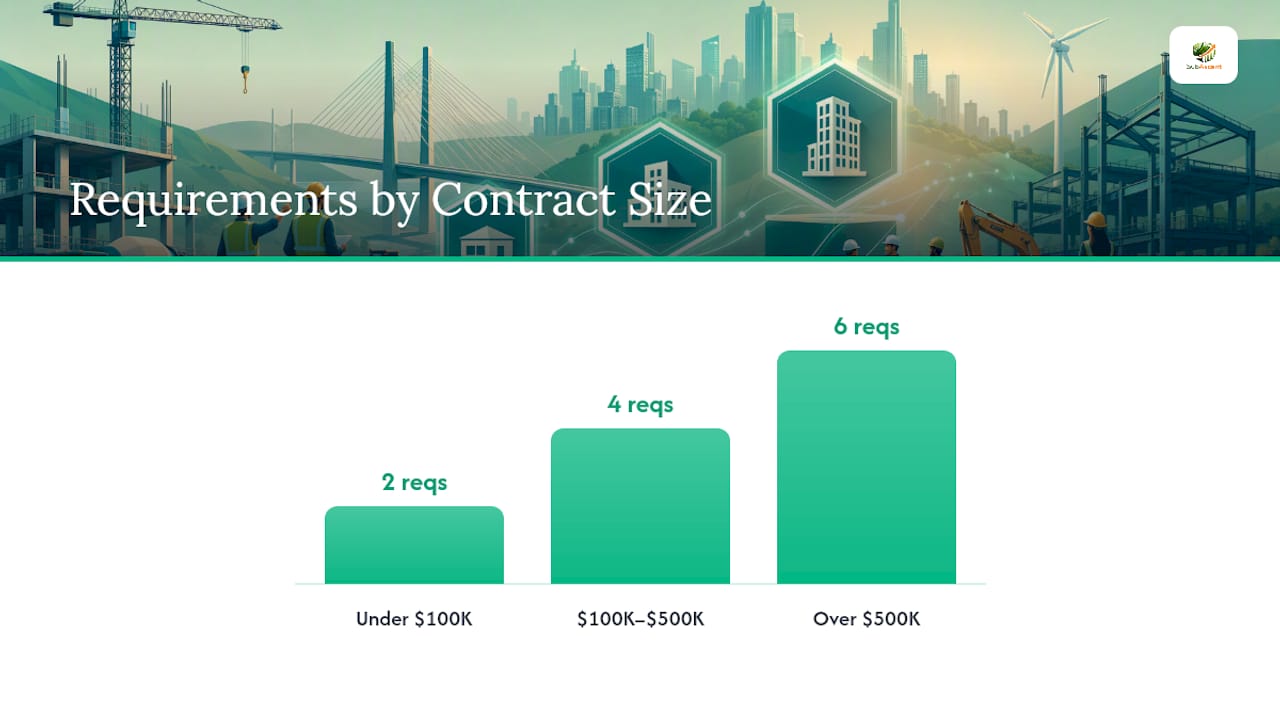
Table of Contents
- What does a trade certification mean for specialty subcontractors?
- How credentials change your bid eligibility and prequal score
- What GCs typically request in a prequalification packet
- How to verify credentials and keep records current
- Typical timelines and costs to get or renew credentials
- How certifications affect hiring, crew deployment, and on-site audits
- A ready-to-assemble prequalification packet you can use today
- The part of prequal that most subs get wrong
- Sources
What does a trade certification mean for specialty subcontractors?
Not every credential on your wall counts the same way in a bid package. Here's how the categories break down.
State contractor license. Issued by your state's contractor licensing board, this is the legal foundation. It carries a license number, an issuing state, and an expiration date. Without it, you cannot legally contract work in most states — and allowing an unlicensed sub can void contracts or create lien risks for the GC. Check your contractor license exam requirements before pursuing work in a new state.
Journeyman and master credentials. These are trade-specific licenses — electrician, plumber, HVAC mechanic — issued by state licensing boards or local jurisdictions. They differ from vocational certificates in one key way: they are legally required to perform the work, not just to demonstrate training. An electrical journeyman license, for example, is a legal prerequisite on most commercial jobs, not a resume item.
OSHA outreach cards (OSHA 10 and OSHA 30). The OSHA Outreach Training Program issues wallet cards after 10-hour (OSHA 10) or 30-hour (OSHA 30) safety courses. Many GC prequals require OSHA 30 for foremen and OSHA 10 for all crew. Beyond the cards, your Experience Modification Rate (EMR) and OSHA incident rates are the safety metrics GCs score. EMR above 1.0–1.2 typically triggers additional review or disqualification on larger projects.

NICET and NCCER certifications. The National Institute for Certification in Engineering Technologies (NICET) certifies fire alarm, fire suppression, and inspection/testing technicians at four progressive levels. The National Center for Construction Education and Research (NCCER) offers craft training and assessment credentials across multiple trades. Both are third-party credentials that carry weight on system-specific scopes where project references alone may not satisfy a GC's technical requirements.
Union affiliation. IBEW (International Brotherhood of Electrical Workers) membership affects bidding on prevailing-wage and public projects. On union jobs, payroll must reflect correct fringe benefit rates and classifications. If you're bidding a public project with a project labor agreement, IBEW affiliation may be a hard requirement, not a preference.
Insurance and surety documents. Your COI (Certificate of Insurance) and surety bond documentation are not certifications in the technical sense, but GCs treat them as credential documents in every prequal packet. A standard prequal captures financial statements, EMR, OSHA logs, bonding capacity, license and insurance verification, references, and key personnel — and third-party verification is expected.
How credentials change your bid eligibility and prequal score
Some credentials are hard gates. Others move your score. Knowing the difference helps you prioritize renewals.
Required (hard gates): State contractor license, COI with correct endorsements, and W-9 are non-negotiable at every contract size. A missing or expired state license will get your bid rejected outright. Same with a COI that names the wrong entity or lacks the GC as an additional insured.
Scored (affect ranking): EMR, OSHA 300/300A logs, bonding capacity, and project references are evaluated and weighted. A fire protection sub with NICET Level III technicians on staff can often substitute that credential for direct project references on a new system type. An HVAC firm with a clean EMR below 0.8 will score better than a competitor with equivalent experience but an EMR of 1.3.
Value-add (differentiate you): Manufacturer certifications — roofing system approvals, fire suppression system authorizations — signal that your crew can install and warrant specific products. On design-assist or performance-spec projects, these can be the deciding factor.
On public projects, prequalification, bonding thresholds, and financial verification are frequently mandated by the owner or project specifications; private work gives GCs more discretion. That distinction matters when you're deciding how much documentation to prepare for a private commercial bid versus a public school or municipal project.
What GCs typically request in a prequalification packet
Tiered prequalification requirements scale with contract value: under $100K typically requires license and insurance; $100K–$500K adds EMR and multi-year experience references; above $500K requires bonding capacity roughly equal to the contract value and audited financials.
Here's what goes in a complete packet:
- Company legal name, address, years in business, trade scope
- State contractor license (copy + license number + expiration)
- COI with required endorsements (GL, workers' comp, auto, umbrella)
- Surety bond letter confirming bonding capacity and surety name
- EMR letter from your insurance carrier (current year)
- OSHA 300/300A logs (prior two years)
- Audited or reviewed financials or bank reference letter (for larger contracts)
- Project references with owner/GC contact information
- Key personnel list with licenses and OSHA card copies
- W-9
- Litigation and claims history disclosure
| Credential | Who Issues It | What It Proves | Bidding Impact | Renewal Cycle |
|---|---|---|---|---|
| State contractor license | State licensing board | Legal authority to contract | Required — hard gate | 1–2 years, varies by state |
| Journeyman/master license | State board or jurisdiction | Legal authority to perform trade work | Required for licensed trades | 1–3 years |
| OSHA 10/30 card | OSHA Outreach Program | Safety training completion | Required or scored | OSHA 10: no expiry; OSHA 30: no expiry |
| NICET certification | NICET | Technical competency (fire/systems) | Required for system-specific scopes | 3 years |
| NCCER credential | NCCER | Craft training and assessment | Preferred/scored | Varies by module |
| COI + surety bond | Insurance broker / surety | Insurance coverage and bonding capacity | Required — hard gate | Annual |
| EMR letter | Insurance carrier | Safety record metric | Scored | Annual |
For a deeper look at bonding capacity and how to improve it, the numbers matter more than most subs realize until a bid gets flagged.
How to verify credentials and keep records current
Verification is where most small firms fall short. Submitting documents is easy. Confirming they're accurate before you submit is the step that gets skipped.
- State license: Use your state contractor licensing board's public lookup tool. Most states publish real-time license status, expiration, and any disciplinary actions.
- COI: Request the certificate directly from your broker, not from a saved PDF. Confirm the GC is named as additional insured and that policy dates are current.
- Surety bond: Call your bonding agent to confirm capacity and get a current bond letter on surety letterhead.
- OSHA cards: The OSHA Outreach Training Program maintains a card verification system. Cards issued after 2015 can be verified online.
- EMR: Your insurance carrier issues an annual EMR letter. Keep the current year's letter on file and request it proactively each renewal cycle.
- Manufacturer certifications: Check the manufacturer's authorized installer or certified contractor roster directly on their website.
For recordkeeping, use a single shared folder (cloud-based works fine) with a consistent naming convention. Assign one person to own the expiration calendar — typically the office admin or project manager. Set calendar reminders 90 days before each expiration.
Pro Tip: The single verification most firms miss is checking whether the GC is named as Additional Insured on the COI — not just that the COI exists. Compliance automation research identifies missing additional insured language as one of the most common COI errors found in audits, and it's the kind of gap that only surfaces when a claim occurs.
Typical timelines and costs to get or renew credentials
Planning ahead is the only way to avoid a credential gap when a bid deadline hits.
- State contractor license: Weeks to months depending on exam scheduling, experience documentation, and state processing times. Renewal fees vary by state, typically $100–$500 per cycle.
- Journeyman/master endorsements: Exam-based; scheduling and processing can take 4–12 weeks in most states.
- OSHA 10: One day of training. OSHA 30: three days. Course costs typically run $30–$100 for OSHA 10 and $150–$300 for OSHA 30 through authorized outreach trainers.
- NICET: Level I can be attempted with limited experience; higher levels require documented field hours. Exam fees run roughly $100–$250 per level. Budget 3–6 months of preparation for Level II and above.
- Manufacturer certifications: One to five days of training, often at a regional training center. Costs vary by manufacturer; many are free or low-cost for active dealers.
- COI and surety bond: Annual renewals tied to your policy cycle. Bonding premiums typically run 1–3% of the bond amount for well-qualified subs.
Multi-state work multiplies all of this. Each state has its own licensing board, exam, and renewal schedule. If you're expanding into a new state, start the licensing process at least 60–90 days before you plan to bid.
Compliance automation can reduce prequalification processing times substantially, from nearly two to three weeks down to a few days. in reported cases — a meaningful difference when you're chasing multiple bids simultaneously.
How certifications affect hiring, crew deployment, and on-site audits
Your firm's credentials only hold up if your crew's credentials match. GCs and owners increasingly audit on-site documentation, not just what's in the prequal packet.
- OSHA cards: Carry physical or digital copies for every crew member. Many GC safety managers check cards at orientation. Foremen should hold OSHA 30; all other crew should hold OSHA 10 at minimum on commercial projects.
- Trade licenses: In licensed trades (electrical, plumbing, HVAC), the journeyman or master license holder must be present or supervising the work as required by state law. Know your state's supervision ratio requirements.
- Manufacturer training: For roofing, fire suppression, or low-voltage system installations, the crew performing the work may need to be on the manufacturer's certified installer list. Verify this before mobilizing.
- Union jobs: On IBEW or other union projects, crew classifications must match the work performed. Payroll must reflect correct fringe rates. Misclassification creates both compliance and audit exposure.
When onboarding a new crew member, collect: state trade license (if applicable), OSHA card, any manufacturer training certificates, and union card if relevant. Log these in your crew roster with expiration dates. A simple spreadsheet works; a crew tracking tool works better when you're managing multiple crews across jobs.
A ready-to-assemble prequalification packet you can use today
Keep one master prequal folder per company, updated quarterly. Here's the structure:
Folder: Prequalification_[CompanyName]_[Year]
License_ContractorLicense_[State]_[ExpDate].pdfCOI_GL_[CompanyName]_[PolicyExpDate].pdfCOI_WC_[CompanyName]_[PolicyExpDate].pdfBond_SuretyLetter_[CompanyName]_[Year].pdfEMR_Letter_[CompanyName]_[Year].pdfOSHA_300A_[Year-1].pdfandOSHA_300A_[Year-2].pdfFinancials_[Year].pdforBankReferenceLetter_[Year].pdfReferences_ProjectList_[Year].pdfKeyPersonnel_Licenses_[Year].pdfW9_[CompanyName].pdf
Tiered packet guidance:
- Under $100K: License, COI, W-9, and a one-page company profile.
- $100K–$500K: Add EMR letter, OSHA logs, two project references with contacts.
- Over $500K: Add surety bond letter confirming capacity, audited or reviewed financials, and key personnel credentials.
When emailing a prequal packet, use a subject line like: [CompanyName] — Prequalification Packet — [Trade] — [Date]. Keep the body short: one paragraph confirming what's attached, your license number and state, and a direct contact for follow-up questions. GCs process dozens of these; a clean, labeled submission stands out.
For a full walkthrough of the prequalification submission process, the step-by-step guide covers what GCs actually score and where most subs lose points.
The part of prequal that most subs get wrong
Most prequal failures I see come down to one thing: the packet was assembled once and never updated. A COI that expired three months ago, an EMR letter from two years back, an OSHA log that stops mid-project. The documents exist; they're just stale.
The fix is simple but requires ownership. One person in the office — not the estimator, not the owner — needs to own the expiration calendar and treat credential renewals the same way they treat invoice follow-up. Set 90-day alerts. When a renewal comes in, update the master folder the same day.
The second most common failure is the COI itself. The GC's name isn't on it as additional insured. The umbrella policy isn't listed. The certificate holder address is wrong. These aren't paperwork technicalities; they're the details that determine whether your insurance actually covers a claim on that job.
If you're managing more than a handful of active bids, manual tracking gets fragile fast. That's when a purpose-built tool pays for itself — not in the credential itself, but in the time you stop spending chasing down documents the week a bid is due.
Sources
- Subcontractor Prequalification: The Keys to Selecting Quality Subs | Procore
- What Is Subcontractor Prequalification? — A GC's Guide to Vetting Trade Contractors | MeltPlan
- Subcontractor Prequalification Process: A Step-by-Step Guide
- Hit 100% Subcontractor Compliance in 60 Days Guide | US Tech Automations